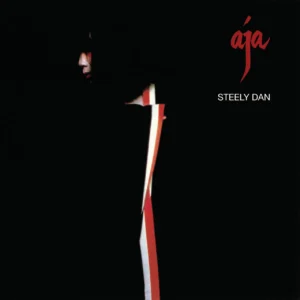
Up on the hill, John Bensalhia thinks Aja is OK. Or so he says. Actually, a lot more than OK, as I look back at all seven tracks of this classic bit of Steely Dan…
Black Cow
The end of 1994 was the point when I became a Steely Dan nut. Having binged on the Royal Scam and Can’t Buy A Thrill tapes all that year, Christmas 1994 bought with it a new CD stereo and a pristine copy of Pretzel Logic on shiny disc. And then as an extra bonus, the local library was selling CDs at very reasonable prices – one of which, by chance, happened to be Aja.
Aja is prime CD fodder. I mentioned the word pristine and that’s a fair summation of Steely Dan’s 1977 classic. Depending on where you stand, the apotheosis of Fagen and Becker’s quest for perfection is either a sonic triumph or a squeaky clean slap in the face to rock and roll grit.
Steely Dan’s attitude was a case of brains over brawn, which is a rare thing in rock. Rather than the usual rock and roll lifestyle cliches, Donald Fagen and Walter Becker instead channelled their energies into creating the most interesting, well-crafted albums ever put on a turntable. Their perfectionism knew no bounds, calling on the cream of local session musicians to help them achieve their vision.
The opening gambit of Aja, Black Cow, is so slinky it purrs. A quietly brooding funk number that tells the tale of a relationship on the skids. Having tired of the “so outrageous” narcissist, Fagen’s sinister sneer is the perfect comeback as he tells her to drink her “big Black Cow and get outta here”. Black Cow, incidentally, is a mix of root beer and vanilla ice cream, and was very popular in the soda pop cafes of the 1950s.
It’s an instant classic and was later sampled by Lord Tariq and Peter Gunz on their Deja Vu earworm (“uptown bebehhh,” etc). To the uninitiated, Black Cow might sound like a mash-up of the theme tunes from The Paul Daniels Magic Show and Quincy M.E, but what does it matter? This is a belter and no mistake.
Aja
Steely Dan’s music has always had its fair share of jazz influences, but the title track is maybe the ultimate expression. What starts out as a tranquil love song becomes a full-on jazz-tinged workout that lasts a mighty eight minutes.
In the ’90s, there was a series of documentaries about classic albums, and surprisingly, one of these was Aja. I say surprisingly, Fagen and Becker were notoriously reluctant interviewees, so it was something of a coup to get them to talk extensively about their 1977 masterpiece.
Fagen describes the title track as a “trip” and a “journey through space and time”, and there’s something quite ethereal about it, a plaintive piano-led shuffle that expands into something much looser and free-flowing. Because Aja was conceived as a suite of sorts – comprising parts of various songs that they had toyed with in the past – it’s the ultimate chance to showcase their jazz chops.
The music is sublime. While it may be too clean for some tastes, the session players are all at the top of their game. The star players in this case are drummer Steve Gadd and saxophonist Wayne Shorter, who bring such raw power to their showcase solos. Given that Shorter had worked with Miles Davis back in the day, it’s no wonder that he was picked for this track that has a definite Kind Of Blue vibe.
Deacon Blues
Let’s get the obvious out of the way. This is the track that’s responsible for the 1980s Scottish warblers. They were huge fans of The Dan, to the extent that they named themselves after the 1977 track – minus the S.
Deacon Blues is described in the documentary by Fagen as being the closest to an autobiography as they’ll get. “We were both kids who grew up in the suburbs, uh, we both felt, you know, fairly alienated, but like a lot of uh, kids in the ’50s, we were looking for some kind of alternative culture, some kind of, uh, escape…”
Any chorus that includes the lines “They gotta name for the winners in the world/I want a name when I lose” was inevitably going to appeal big style to an outsider like me. It’s the perfect ode to all the outsiders, social misfits, introverts, etc, in the world, but it never gets bogged down by mawkish sentiment or overblown arrangement. Nevertheless, in its own quiet way, I still find it remarkably moving.
Peg
Technically, the first time I’d ever heard of Steely Dan was in 1989. Rap trio De La Soul were in their prime that year, and one of my favourites was Eye Know. I’d always been into interesting and unique sounds, and that strange, warbling electric piano caught my attention. I’m sure I filed Steely Dan at the back of my mind to check out in the future.
The raw source material Peg is a progression from 1976’s The Fez in that it’s more disco-based than usual. It’s not full-on KC by any means, but by Becker and Fagen standards, they’re breaking out the white satin flared suits and platform boots.
What prevents Peg from becoming generic dancefloor fodder is is its interesting soundscape. The Dan were known for being perfectionists, but Peg took it to extremes by getting through not one – but seven – different session guitarists to find the guitar solo they wanted. In the end, it was Jay Graydon that finally managed to impress, and his unorthodox Hawaiian-esque riff fills the spot superbly.
Another notable element of Peg is Michael McDonald’s overdubbed backing harmonies. McDonald had been notably heard on Steely Dan’s Katy Lied album, and by now, was a fully-fledged Doobie Brother. His unusual but distinctive tones are a core part of Peg’s aural appeal, and as well as McDonald, co-writer Paul Griffin can be heard doing some improvised scatting in the background, too.
Home At Last
Not-we cynics may scoff at Aja’s lack of emotion, but I think it’s one of the most personal records they produced. As well as the tranquillity of the title track and the autobiographical nature of Deacon Blues, there’s also the wistful homesickness expressed on Home At Last.
Missing New York, Fagen and Becker put pen to paper, coming up with this nicely laidback bit of… yacht rock? The phrase has become one of those recent lazy journalistic cliches to try and compartmentalise every East Coast/West Coast act under the sunny skies, but again, Steely Dan’s quest to come up with quirky, interesting soundscapes means that Home At Last is so much more.
When I was a kid, I was obsessed with records. To the point where I would furiously scour mum and dad’s records one by one. I would take the inner sleeve out of the cover and studiously read the credits. I think that’s why names like Bernard Purdie rang a bell years later. Purdie was an accomplished session drummer, and his skills are put to perfect use here. “He always had some unique stylistic thing,” recalled Becker in the documentary, and what the man himself calls the “Purdie Shuffle” is one example of this hugely talented drummer’s repertoire.
I Got The News
Aja was released at the same time that punk rock was making its presence felt. Its clear-cut, pristine production values are the result of a year’s worth of recording sessions. I Got The News is a classic example of Fagen’s and Becker’s super-sheen perfection – a sparse, piano-driven mover that’s chock full of near little touches such as Victor Feldman’s gameshow-style vibraphone and Fagen’s ARP synth creating that extra bit of orchestral swoop.
The antithesis of punk, Aja would probably have been sneered out the door by Johnny Rotten – most likely on the grounds of it not being edgy enough to be the soundtrack of a butter advert.
But Steely Dan had the last laugh. Ian Dury was a well-known fan of the Dan, and he was filmed for the classic albums doc on Aja, praising its upbeat qualities. He summed it up neatly with this quote: “I don’t really wanna hear people moaning, and I don’t wanna hear music that moans”.
Snow Patrol could learn a thing or two from this.
Josie
A last breezy bit of what Fagen calls “R&B”. “It has a lot of stuff I like about it,” he says on the doc. “Y’know like a Junior Parker or Bobby Bland record.” Becker also praised the track, claiming it was the one he liked playing the most.
As one of the more commercial offerings on Aja, unsurprisingly, it was selected as the third and final single. In fact, all three of the released singles did quite well, with Peg just missing the Billboard Top 10 (11), Deacon Blues sneaking it at 19, and Josie being the lowest performer at 26 – although by the time it was released in Summer 1978, most folks probably had the album anyway.
Bassist Chuck Rainey says that he provided a funk groove, and it’s another stellar example of the talents assembled to help create Aja. Again, the incidental elements all add up to give it that unique Steely Dan sound. Jim Keltner the drummer, hits garbage can lids at one stage, while Fagen channels his inner Mancini by using an ARP string ensemble to make what he calls an “early detective type thing.”
Aja doesn’t put a foot wrong, and is still one of Fagen’s and Becker’s best albums. Commercially, it’s their best performer, spending over a year on the Billboard 200 chart, and going Top 10 in many countries including New Zealand and even in the UK (their first Top 10-er here). All testament to an approach that ultimately paid off in spades. An easy must-buy for any new fan of 1970’s music.
(Cover design credited to Oz Studios, Patricia Mitsui, Geoff Westen and Hideki Fujii)
If you liked this article, you might like some of my other books which are available to download at Amazon: My Books
