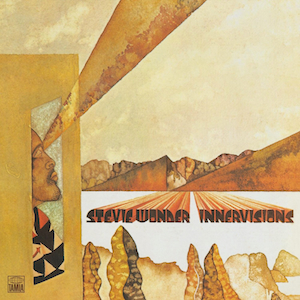
Man with no plan, Misstra-Not-Know-It-All, John Bensalhia is your guide to this classic Stevie Wonder platter from 1973…
Too High
13 years before Zammo McGuire was found slumped against a toilet wall in Grange Hill, Stevie Wonder came up with his very own Just Say No in the form of Too High. I’m sure that those Grange Hill kids meant well, but Wonder’s Too High knocks the 1986 charity single into a cocked hat that contains Mr Bronson’s wig.
As an opening meet and greet, Too High makes an immediate impression. Its arrangement is simply astonishing. Within seconds, Wonder’s managed to include umpteen chord changes, thanks to that brilliantly unusual “Do duh do do do duh do” scat from backing singers Lani Groves, Tasha Thomas and Jim ‘Swing Your Daddy’ Gilstrap. While Wonder’s 16th album is predominantly soul, other influences have crept in, such as classical, rock and – in this case, jazz.
It’s an interesting contrast. For all its rapid chord changes, Too High prowls along with a cool, calm, collected poise. Wonder keeps things on an even keel, resisting the temptation to descend into vocal histrionics – instead letting his vivid lyrics tell the story of a “girl in a dream” who “sees a four-eyed cartoon monster on the TV screen.” Living in a “superficial paradise”, there’s only one inevitable outcome for this girl as the news reports that “she passed away”.
I have hummed and hawwed about doing Top 10 lists on my blog for music artists such as Stevie Wonder. In this case, both the album and this track would comfortably lodge around the top. Too High is one of the all-time great Wonders of the world, and makes for a flying start to one of his greatest album accomplishments.
Visions
If Too High was all Stevie’s own work – bar backing vocals – Visions allows a few session musicians to come and join his party. No drummers allowed though, as it’s just Malcolm Cecil on upright bass, Dean Parks strumming the acoustic guitar and David T Walker on the electric guitar.
I’d previously not paid so much attention to this wispy ballad, but the older I get, the more I’m struck by the insightful lyrics which reflect on the fragility of life. Wonder seems genuinely gobsmacked that “a place like this” could “exist so beautiful”, wondering if instead we “have to take our wings and fly away to the visions in our minds”. The most evocative thought is that green leaves “only change to brown when Autumn comes around”. As someone whose face falls whenever October comes around, it’s a strangely reassuring notion.
Living For The City
One of the hit singles to be snatched from Innervisions, Living For The City was the second to be chosen – making the Top 10 in America and grazing the Top 20 in the UK, Germany and New Zealand.
It deserved to do better, but possibly, the cut-down version didn’t quite have the same impact that the original seven-plus-minute album version had. This is extraordinary work, a menacingly cautionary tale of racial prejudice. It tells the tale of a smart young chap from Mississippi, whose parents have experienced hard times, working all hours for little reward. Hoping to make a better life for himself, the young man goes to New York City, where a chance encounter with a drug dealer leaves him framed, arrested and ultimately imprisoned.
Living For The City pulls no punches, right down to the derogatory language snarled by the prison staff. It’s also breaking new ground, being one of the first soul tracks to incorporate everyday street noises of traffic, voices and sirens, which are then melded in with the studio sounds and dialogue from Wonder, Wonder’s brother Calvin, Ira Tucker Jr and Jonathan Vigoda.
The track would be covered by the likes of Ray Charles and Gillan, but they don’t have anywhere near as much power as this blistering original.
Golden Lady
To cool off after the sweaty claustrophobia of Living For The City, Wonder returns to a simple love song. Actually, let’s not be hasty. Simple is doing Golden Lady a disservice, as like all other tracks on Innervisions, it’s expertly structured with a fresh, interesting chord structure – heard at its best at the gradual end fade-out in which Wonder goes through about a million and one chord changes that would leave any mopey power balladeer weeping in jealousy.
Like the previous track, Golden Lady makes great use of what was known as T.O.N.T.O (The Original New Timbral Orchestra), a synthesiser system that was the brainchild of Malcolm Cecil and Robert Margouleff – both of whom had persuaded Wonder to branch out into other song subjects apart from love. Wonder’s T.O.N.T.O work meshes well with Clarence Bell’s Hammond organ, which gets progressively more frantic towards the rapid chord change finale. It’s driven throughout by some sterling conga work from Larry ‘Nastyee’ Latimer.
Higher Ground
There’s something to be said for the power of music when it can be used in the worst of times. Three days after the release of Innervisions, Wonder was seriously injured in a car crash. Wonder’s brain contusion was so severe that he was in a coma for 10 days – but as his friend Ira Tucker recalls, he softly sang a few bars of Higher Ground to Wonder while at his bedside. Incredibly, Wonder’s fingers started to move slowly in time with Tucker’s singing rhythm. Fortunately – despite losing his sense of smell (which would later largely return) – Wonder would make a full recovery.
Ironic, given that Higher Ground’s lyrics tackle the concept of reincarnation. When interviewed by the New York Times, Wonder later acknowledged that subconsciously, it was as if he was being told that he would be given a second shot at life.
The first single to be picked from Innervisions, Higher Ground whetted the appetites of American record buyers, speedily racing to Number Four in the Hot 100. Despite the serious nature of its lyrics, it’s instantly funky and danceable and has a rhythm that sounds like the thing was recorded while jumping up and down on a bouncy castle.
Jesus Children Of America
One of my earlier blog entries leapfrogged Innervisions by scrutinising the follow-up album, Fulfillingness’ First Finale track by track. I only talk of this because of Heaven Is 10 Zillion Light Years Away, which I found too on-the-nose happy clappy for my tastes.
Jesus Children Of America was an earlier comment from behind the pulpit, and it’s much more my cup of tea. The moody soundscape is a lot more interesting for one, as Stevie goes it alone, playing every single instrument, right down to the tambourine and accompanying hand-clapping. The minimalistic Moog bass punctuates this track throughout, as Wonder turns in one of his most impassioned vocal turns (which he’ll then surpass on the next track!).
I get the impression that he’s taking a pot shot at certain extreme religious leaders and/or fanatics, confronting them regularly with those simple lines: “You’d better tell your story fast… And if you lie, it will come to pass”. Wonder’s religious faith is a common theme of his work – but as he points out, in the wrong hands, it’s not a force for good.
All In Love Is Fair
So… that surpassed vocal performance from Stevie, then. All In Love Is Fair is a simple, plaintive ballad that dissects the end of a relationship in downbeat fashion. To play Devil’s Advocate, some of the lyrics are a bit corny. Wonder, by turns, compares love with playing a game, fighting a war, and an empty road. Maybe the writer should have taken his pen to scrub out some of the lyrics again.
But where Fair wins out is in Wonder’s emotional reading. He wrings out every scrap of emotion from the words, eventually culminating in a prolonged holler of “FAAAAAIIIIIRRRRR” at the song’s dramatic climax. Wonder was a multi-tasking genius, but let’s not forget that he was also gifted with one of the finest soul voices of his time.
Don’t You Worry ‘Bout A Thing
Mrs B says that this should be my theme tune. If you somehow stayed awake for my blog post about Jethro Tull’s Stand Up, I fleetingly mentioned how anxiety loves to have the last laugh in my miniscule, crumb-sized brain. What I’d give to swap craniums with someone who adopts Stevie Wonder’s mantra of “Don’t You Worry ‘Bout A Thing”. If anyone knows of a spare brain shop, please drop me a line.
Anyhoo, the carefree lyrics aren’t the only joyous element of this penultimate track. Wonder’s gone all out to provide a carnival party atmosphere with Yusuf Roahman and Sheila Wilkerson on percussion instruments including maracas, bongos and gourds. Wonder sounds like he’s having the time of his life, cheekily boasting about his worldwide globetrotting in the intro. Incidentally, the “todo está bien chévere” translates as “Everything’s cool” in Spanish.
An enjoyable interlude before the finale, Don’t You Worry ‘Bout A Thing was covered by Incognito in 1992 with diminishing returns – plus even more shrunken returns from caterwauling Tori Kelly, who over-emphasised every single syllable in the 2016 movie, Sing.
He’s Misstra Know-It-All
One of the (many) highlights of Innervisions, He’s Misstra Know-It-All has a lot in common with its conman subject – in that you think it starts off one way, but then it ends up taking the opposite route.
It starts off in slow-burn fashion, a sedately paced mid-tempo groove – before all hell breaks loose in the mad cacophony of vocals and hand claps that slowly fades this classic into the run-out label for good. While I’ve criticised Wonder previously for repeating the same groove for too long, here, I think he gets the balance just right. The last repeated cries of “He’s Misstra Know-It-All” aren’t overplayed to the point of annoyance, instead bringing this great album to a thrilling conclusion.
The track was released as a single in Spring 1974, just about breaching the Top 10. The album itself also did very well, spending over a year in both British and American album charts, making numbers eight and four, respectively. Innervisions sees Wonder at the very height of his powers – there’s not one duffer to be found here – I’d go so far as to say that it’s the very best album he ever made.
(Cover art credited to Efram Wolff)
If you liked this article, you might like some of my other books which are available to buy at Amazon:
Amazon.co.uk: JOHN BENSALHIA: books, biography, latest update
