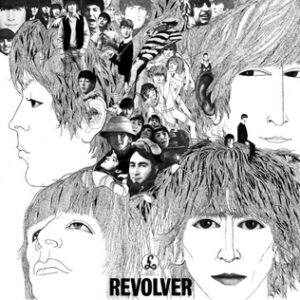
Turn off your minds, relax and float downstream with a look back at The Beatles’ classic album, Revolver, which impossibly hits the Big 6-0 today…
Taxman
If there’s a fate worse than death, then it’s paying tax.
Autumn brings many reasons to feel down in the mouth. The sun clears off. The trees and flowers start to wither and lose their colour. The nights get darker. And on top of this, there’s that wretched self-assessment form to complete – culminating in the rapid shrinking of your already paltry bank balance.
For The Beatles though, back in 1966, the government’s imposition of high progressive tax must have stuck in the collective craw. It’s said that out of their earnings, around 95 per cent ended up in the clutches of the taxman – hence George Harrison bemoaning: “There’s one for you, 19 for me.”
George’s growing stature as songwriter hadn’t gone unnoticed, as Revolver breaks in tradition by kicking off with one of his compositions. Taxman ranks among his very best work, a biting diatribe against Wilson’s Labour government’s decision to super-tax his earnings. The bitterness of the lyrics is echoed in the sparse, brittle arrangement – driven by Ringo’s pounding snare drum, Paul’s booming bass and the snappy, clipped guitar chords from George. McCartney also contributes a crazed guitar freak-out after the band have collectively chimed “Taxmaaaan!”
Is it me, or does that bit remind you of the Batman theme tune?
A great kick-off to this Beatles classic, and I also like George’s initial pithy Scrooge impersonation as he tries and fails to count down the intro.
Eleanor Rigby
My first acquaintance with Revolver would have been fleeting, as it came via the 1962-1966 Beatles compilation from 1973. The last two tracks were the only samples from Revolver, which strikes me as odd, as Rubber Soul gets a comparatively generous six tracks – that’s nearly half the album!
Because Mum and Dad would treat us to their record collection on Sundays (and 1962-1966 always reminds me of family Sunday lunchtime roasts), it’s appropriate that Eleanor Rigby has that haunted, end-of-weekend feel. A ghostly study of loneliness, the ballad is unusual in that none of The Beatles contribute anything musically, but vocals. A brave move to take as a single release, as it was unlike any 45 that The Beatles had released before. Nevertheless, the risk paid off, as it sped to the top of the charts as a double A-side along with its irritating younger brother (more on this in a mo).
Who was Eleanor Rigby? Originally known as Daisy Hawkins, some have suggested that the first name was inspired by Eleanor Bron, who appeared with the band in their Help movie. As it later turned out, a real-life Eleanor Rigby’s gravestone was discovered. She’d passed away in 1939 at the age of 44, and to confound the conspiracy theories, a nearby gravestone bore the name of McKenzie, the name of the priest who conducts the mourner-free funeral of Eleanor, and who subsequently loses his faith. Coincidence? Or something else?
All of this argy bargy spilled over into the writing credits, with John laying claim to writing either 50 or 70% of the lyrics, and Paul later arguing that the balance was more 80-20 in his own favour. What isn’t disputable though is that Eleanor Rigby is one of the most memorable and fascinating Beatles ballads in their pantheon.
I’m Only Sleeping
I wasn’t sure what to expect when I managed to buy a copy of Revolver in Spring 1992. The local library used to sell used tapes, and one of these happened to be the acclaimed Beatles LP from ’66. I’d always wanted this album, ever since I read about it in one of Mum’s John Lennon magazines. That striking cover art from Klaus Voormann – part collage, part caricature – always fascinated me, so I did feel a little short-changed that I didn’t get a proper LP package with a poxy cassette that shrank the cover even further to practically the size of a postage stamp.
I think I recall predicting that I’m Only Sleeping would be some psychedelic maelstrom of chaos, but it’s no such thing. It’s a bright, zingy pop ditty that does boast some natty reverse guitar trickery. And while you could argue that it’s about drugs, I’m Only Sleeping is no simpler than what it purports to be – an ode to the joys of sleeping. One of Lennon’s pals, Maureen Cleave, once described him as “probably the laziest person in England”.
Like many Beatles tracks, even the more obscure examples would be targeted for cover version use – the most prominent one being Suggs in the mid-90s, who reworked it into a plodding mid-groove that was nearly as lazy as heavy sleeper, John Lennon.
Love You To
Pull up your sitars, boys and girls… It’s Ravi-oke time!
By 1966, George Harrison had become a committed fan of Indian music, frequently citing sitar player, Ravi Shankar as a huge influence. He’d previously dabbled with the sitar on Norwegian Wood, but on Love You To, he takes the influence to extremes. This is pretty much all George’s own work, with Ringo only contributing a beat or two from a tambourine, and Macca only chipping in with the odd harmony vocal. Meanwhile, John’s completely out of this equation.
It’s not my favourite of the album by any means – and if push came to shove, I’d nominate the follow-up, Within You Without You from Sgt Pepper as the better of the two. But it does spotlight how far The Beatles had come within the space of only three years. Not only was George playing a more prominent part in proceedings, the quartet were now actively flirting with different styles of music beyond beat rock ‘n’ roll. It’s a vision that can only be applauded, with Love You To being only a fraction of The Beatles’ expanding musical vocabulary.
Here There And Everywhere
Being a frequent record shop visitor, I remember browsing my way through The Beatles’ section – age six and three quarters – in the Summer of 1981. Their latest offering was a compilation called The Beatles Ballads, and the thing that instantly caught my eye was the eerie cover artwork, a mournful caricature of the band at a point in time of 1968. Apparently, this was a mooted – but rejected – cover pitch for what would become The White Album.
In the background, I remember hearing an equally downcast ballad playing. I could never remember the name of it until I chanced upon the Revolver tape in ’92. “Oh! It’s Here, There And Everywhere that was playing that Summer!”
A mellow love song from the pen of Macca… I say mellow, but it’s taking the meaning of that word to extremes. A lilting finger-click of a ballad, Here There And Everywhere is said to have been inspired by The Beach Boys’ God Only Knows – and somewhat obliquely, Marianne Faithfull. A nice bit of romantic Summery bliss that may well be just the ticket for romantic picnic soundtracks.
Yellow Submarine
The thing I remember about Yellow Submarine is some snivelling kid at school pointing out the paucity of the lyrics’ logic. “If they all live in a Yellow Submarine, why do many of their friends live next door?” he spluttered. Damn it, Snotty Kid was right. If that was the case, you’d have to rename it Yellow Submarines.
But then trying to make any kind of sense of Yellow Submarine is a complete waste of time. It’s a silly kids’ song, no more no less. You’d get as much sense out of it as say, writing a dissertation on the social implications of Shaddap You Face by The Joe Dolce Music Theatre.
You’ll either love this track… or not so much. I’ll freely admit I’m in the latter miseryguts camp here, but then that’s just me in typical Meldrew Mode, which these days, is par for the course. For me, it’s an annoying fingerpaint on an otherwise 10/10 album. Anyway, my blog, my rules – so there!
She Said, She Said
Moving swiftly on… Let’s get back on track with the much better She Said She Said, the last track to be cut for the album, and one that’s said to have been inspired by a chance encounter with actor, Peter Fonda during an LSD trip the previous year.
Adding an extra S to the “he said”, Lennon recalled Fonda’s comments during a party held at Beverly Hills. One of the guests was Fonda, who decided it would be a wheeze to babble about a near-fatal gunshot wound that he’d sustained when he was younger. An unimpressed Lennon remembered the “I know what it’s like to be dead” choice of phrase, something he didn’t want to hear – and subsequently used it in the lyrics.
The genesis of She Said She Said was said to have been piecemeal, with the three or so separate strands woven together by both Lennon and Harrison. Todd Compton goes so far as to suggest that both John and George are the primary composers in his 2017 book, Who Wrote The Beatles Songs.
Good Day Sunshine
I’m currently typing out this latest bit of blog waffle on a hot Summer’s day. It’s the hottest it’s been since… ooh, last year. I’m expecting next year to bring weather so hot that each time I leave the house, my shoeface will melt off its skull. I’ll have to stick it back on with superglue or something.
What better choice of soundtrack than Good Day Sunshine? A singularly Summery delight, and one of the many high spots on Revolver. If Here There And Everywhere had taken its cue from The Beach Boys, Good Day Sunshine looks to The Lovin’ Spoonful for inspiration. John Sebastian and co had been one of the breakthrough sensations of 1966, with Daydream providing a possible source of influence.
The key to Sunshine’s appeal is that it keeps things simple. Rather than over-egging the pudding, McCartney relies on the catchy, good-time nature of the track to make an impact in its own sunny way. I do like the honky-tonk style piano though, barrelling away in the background, to add a touch of the Vaudeville to this gem.
I bet it’ll chuck it down with rain, tomorrow, though.
And Your Bird Can Sing
For a song that’s been variously dismissed by its creators as no more than throwaway fluff, And Your Bird Can Sing remains the hardest to pin down on this collection. On the surface, a lovely snatch of ’60s jangly pop rock, with maybe just a tip of the hat to The Byrds (And Your Byrd Can Sing, huh?) underneath an enigma.
Many schools of thought as to what it concerns. A possible retort to Frank Sinatra, who had been none too complimentary about the quartet in an edition of Esquire magazine. A maybe thumb-nose to Mick Jagger, whose “bird” at around this time was Marianne Faithfull. A potential musing on a bizarre gift from Lennon’s wife Cynthia of a clockwork bird in a gilded cage.
Who knows? That’s the great thing about music. You can interpret it any way you wish – even the outtake of the band bursting into uncontrollable laughter on the second Anthology album.
For No One
See, everybody seems to rate boring old Hey Jude as prime Macca material, when one of his greatest achievements with The Beatles was lurking on Revolver all this time.
For No One is another instance of The Beatles spreading their wings and charting new musical waters. It takes root from older-style baroque music, with McCartney sadly lamenting a break-up over the unusual choice of a clavichord backdrop. To compound the woe, Alan Civil parps on a French Horn. Many Beatles songs have aimed for melancholy, but For No One hits the bullseye from the word go, one of the best of its kind.
Displaying the sophisticated maturity of The Beatles’ new direction, For No One is essentially a two-hander between Paul and Ringo, who contributes a suitably sluggish percussion rhythm. Instantly addictive.
Doctor Robert
Mum’s a huge John Lennon fan – hence me name – and as well as magazines, she bought a few books that I remember sneaking a look at when I was a nipper. In one of those brick-sized tomes was a sizeable guide to Revolver, and one of the descriptions that stuck with me was Doctor Robert, the enigmatic surgeon who provided patients with a “drink from his special cup”.
I’m sure the drug allusions sailed over my innocent head at that point. These days, you’d have to be lobotomised not to make the drug connections. Like And Your Bird Can Sing, there’s been much speculation as to who the Doctor is with choice candidates including New York doctor to the rich and famous, Robert Freymann; art gallery owner and alleged pot one-stop, Robert Fraser; and even Bob Dylan.
Whereas some of the tracks on Revolver are quintessentially Macca, this one is more the work of Lennon, with its satirical lyrics and wordplay. The choppy, clipped guitar chimes do recall the earlier Taxman, but there’s a lovely, dreamy breather in between verses that sure is “feeling fine”.
I Want To Tell You
If George had started out contributing the odd one – or two, if he was lucky – track to Beatles albums, by Revolver, he’s become confident enough to supply a trio, all of which are very good.
Said to have been inspired by the creative inrush of thoughts brought on by LSD, Harrison wanted to translate these thoughts to tape. In his biography I, Me, Mine, he described the experience as “an avalanche of thoughts that are so hard to write down or say or transmit”.
Musically, I Want To Tell You isn’t quite as experimental as others on Revolver. But it’s a sturdy bit of guitar-driven power pop and further evidence of Harrison’s burgeoning songwriting skills. Even if Macca’s high-pitched backing harmonies are maybe a bit too prominent in the finished mix.
Got To Get You Into My Life
One of the reasons I like Revolver a lot (Yellow Submarine, notwithstanding) is that it continues to surprise and delight right until the end. So far, we’ve had everything from baroque clavichord to Indian sitar, and now along comes a bit of classic soul thrown into the mix.
This is one of McCartney’s most enduring compositions. The horn arrangements are inspired, and a quick mention to producer George Martin for realising The Beatles’ musical vision with such thought and care. The trumpets and tenor saxophones lend this one extra class, summing up those good old Motown 45s from across the pond.
Paul’s vocals are equally assured, moving from his usual pop voice to that occasional raspy growl that he used from time to time. He could have been a great soul singer in his own right. The track was popular enough to get a few cover versions, the most prominent being a decent attempt from Earth Wind And Fire 12 years later.
Tomorrow Never Knows
It’s inconceivable to think that Revolver turns 60 today. Nothing really screams out “dated” here, still sounding as fresh and relevant as it did in 1966 (well, Mum says it sounded fresh and relevant back then). Furthermore, it still sounds strikingly ahead of its time, and there’s no better example than the concluding track, Tomorrow Never Knows.
Tomorrow Never Knows is one of those Beatles songs that defies description. On the surface, it sounds like the inner workings of a madman, a furious psychedelic whirlwind of sound collage. Listen to it closely though, and marvel at the sheer effort and hard work that went into realising this oddity. I don’t think that there was anything quite like this doing the rounds in the charts at the time.
The treated sound effects (including frequent bursts of parping brass, honky-tonk piano playing and the adjustment of Macca’s vocals to make him sound like a wailing ghost throughout) and the eerie, faraway vocal turn of Lennon to make him sound like a Dalai Lama singing from a far-away mountain top all come together to create something unusual, compelling and just a little bit terrifying. Phil Collins actually made a decent fist of this as the swansong on his Face Value album, but the original has never been bettered. What a way to say goodbye to one of the most essential Beatles records in their discography.
(Cover art credited to Klaus Voormann)
If you liked this article, you might like some of my other books which are available to buy at Amazon:
Amazon.co.uk: JOHN BENSALHIA: books, biography, latest update
