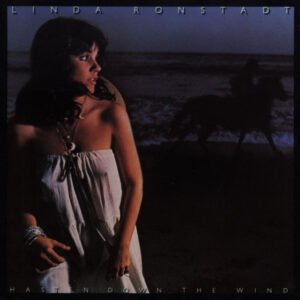
That’ll Be The Day when you say a good hi to a classic album from one of the greatest female vocalists of all time…
Lose Again
Hasten Down The Wind wastes no time in getting down to the nitty gritty. Lose Again is straight in the thick of the action, as Linda Ronstadt wistfully protests: “Save me… free-ee-ee me from my heart this time”. No build-up, no introductory drum solo… instead Lose Again launches the album with its greatest asset – Linda’s voice.
While Hasten Down The Wind does contain one or two Ronstadt originals, for the most part, it sticks to the tried and tested formula of well-chosen and interesting cover version choices. Three of these – including Lose Again – come from the pen of singer-songwriter, Karla Bonoff, who was, by 1976, making a name for herself on the songwriting circuit. Bonoff had originally been a member of short-lived late ’60s band, Bryndle with Kenny Edwards and Andrew Gold – two of Ronstadt’s regular backing band members. I guess it was inevitable that Karla’s and Linda’s paths would cross, and the other Bryndle member Wendy Waldman also sings back-up on a couple of Hasten tracks too.
The Bonoff tracks are among the best on the album, and this power ballad kicks it off in fine style. Linda’s sensitive vocals are made for this one, alternately belting out and delicately whispering the lovelorn lyrics. The third track to be chosen as a single, it didn’t perform quite as well, just missing the Top 75 of the Billboard Hot 100. I’m not sure if the single release is an alternate take, as the promo video of Ronstadt giving it some welly in the recording studio is a different version to the one on the album.
The Tattler
The Tattler has a complicated genesis in that it’s effectively a cover of a cover. Originally, it started out life as a two-part gospel blues number called You Can’t Stop A Tattler, which was written and played by Washington Phillips in the late 1920s.
Around 45 years later, Ry Cooder rearranged the track, shortening the name to just The Tattler. Bolting on a couple of verses from Part One to the second part this was included on Cooder’s 1974 Paradise And Lunch album. This was the version that was picked on for inclusion on Hasten, and it’s a whimsically charming, laidback breather after the intensity of Lose Again.
If He’s Ever Near
Hasten Down The Wind has been praised for its emotional maturity, an album that charts the highs and lows of love. I’m not sure who decided on the final setlist of songs – whether it was canny producer Peter ‘Him With Gordon/Brother Of Jane’ Asher or Linda herself, or both – but the end product is an inspired run that seamlessly balances pop smarts and heartbreak.
If He’s Ever Near – the second Karla Bonoff track – is one of the best on the album, and works on account of its muted world-weariness. The first verse is pretty much Linda quietly singing over a lone organ note from Andrew Gold and a gossamer-thin drum tap from Russ Kunkel. Ronstadt’s quiet despair over whether she’ll find the right guy is all the more effective than decibel-busting top volume, and her hushed, almost conversational approach is in tune with the surrounding arrangement – right down to Waddy Wachtel’s solemn slide guitar and the angelic background harmonies from Ronstadt, Wendy Waldman and Karla Bonoff herself.
In a world of bombast and bluster, there’s always welcome room for tracks like If He’s Ever Near. It may be one of the quietest tracks in tone, but its subtle emotional power shouts the loudest.
That’ll Be The Day
For every haunting ballad, there’s a more uptempo floor filler. Guaranteed to get ageing Teddy Boys dragging their partners on to the dancefloor, Linda’s version of the Buddy Holly classic was the first single to be taken from the album, resulting in a successful Number 11 placing on the Billboard Hot 100.
Ronstadt seemed to be quite the Holly fan, having covered It Doesn’t Matter Anymore on 1974’s Heart Like A Wheel, with her version of It’s So Easy waiting in the wings on 1977’s Simple Dreams platter. While That’ll Be The Day doesn’t do anything radically different, it’s still a fun, pleasant way to spend two and a half minutes.
Lo Siento Mi Vida
Quick language lesson. Lo Siento Mi Vida translates as I’m Sorry, My Love. Google the translated version lyrics of this track, and it’s even more blubby than the original! “I’m sorry my love/I know that it’s over now/Broken hearts/The hope that’s gone…”
Where’s me hanky?
This sobathon is one of the two Ronstadt-penned originals. It was co-written with band member Kenny Edwards and also her father, Gilbert. As well as being a local machinery merchant in Tuscon, Linda’s dad was an accomplished baritone singer and an influence in her exploration of her Mexican heritage in music. As well as co-authoring Lo Siento Mi Vida, Gilbert would play a major part in shaping the 1987 album Canciones de mi padre (Songs Of My Father).
Hasten Down The Wind
Werewolves Of London were lying in wait around the corner in 1976, as for now, cult singer-songwriter Warren Zevon could pride himself on nabbing the title track honours.
Taken from Zevon’s eponymous debut, the Ronstadt version is sensitively handled – a sad enigma of a track that tells the tale of a relationship’s dying days. Pity the poor chap who notes that his missus “is so many women” but yet “can’t find the one who was his friend”. The sorrow of the tale is evoked in David Campbell’s downcast string arrangement and Eagle Don Henley’s harmony vocals.
Rivers Of Babylon
A quick a cappella burst of the song that was a hit for the Melodians and more memorably, Boney M. Nice harmonies from faithful stalwarts Kenny Edwards and Andrew Gold – but not really much to offer in the way of discussion.
So let’s instead concentrate on how well the album did in the charts. While it didn’t chart any higher than Number 32, Hasten Down The Wind was at least the long-awaited UK chart breakthrough for Linda, spending eight weeks in the album survey that Autumn. Hasten fared better in Canada and Holland, making the Top 20, but its best chart showing was in America. A hugely popular smash at Number Three on the Billboard 200, Hasten spent 36 weeks hanging around the charts, attaining Platinum status.
Give One Heart
One contemporary reviewer was decidedly unimpressed with the reggae-tinged Give One Heart. Writing for Rolling Stone, David McGee declared it as “one of the worst songs” that he’d ever heard. Huh. McGee should have tried time travelling a few years into the future. The Millennium Scare… Wondercaterwaul… That one by Crazy Frog… The list of horror could go on for aeons.
Give One Heart isn’t the strongest offering on Hasten by any means. Maybe the lyrics are a tad twee, and maybe Linda’s “scream” (as complained about by McGee) does seem a bit off in the middle bridge, but if nothing else, it’s a lot of fun – a perky piece of contemporary reggae that functions as a last breather before the real heartaches begin.
Try Me Again
One of the last examples of Linda’s songwriting skills, Try Me Again was written with Andrew Gold (who would be about to embark on a successful pop career in his own right). It does raise the question of why Linda decided against writing any more songs in the future.
The sheer melancholy of Try Me Again may suggest that it was all a bit too much for the singer. It’s said that Ronstadt penned the lyrics after driving past her ex’s house, and the words are packed full of emotional turmoil – enough to fill a year’s worth of EastEnders torment. “Friends I saw they just brought me down, they’re so cynical and bitter,” sighs Linda, bitterly. “Well I guess I’m just like them now, I never thought I’d turn out like that.”
Because of the personal nature of Try Me Again, Ronstadt comes up with one of her very best vocal turns on the album, knowing when to pitch the emotion – sometimes a hushed, resigned whisper, at other times, a plaintive wail. The emotion practically leaks tears out of the speakers – powerful, and one of the most striking tracks on the album, but it’s likely that Ronstadt didn’t want to put herself through the emotional songwriting wringer again.
Crazy
Having listened to countless albums during my near 52 years on this planet, it’s struck me that a fair few tend to run out of steam towards the end – almost as if certain bands and singers give up trying.
Hasten Down The Wind is not one of those albums. If anything, it saves the best till last with its closing trio of tracks – one of them being an inspired take on Willie Nelson’s old chestnut, Crazy.
I’ll admit that when I first tracked down the album in February 2000, I wasn’t expecting any great shakes from Crazy. The Patsy Cline version had been re-released as a single in the early ’90s, and I don’t think I was especially impressed to be honest – apologies, you can burn me at the stake if you like.
Linda’s version, however, adds a whole new spin on it. A bluesy, last orders at the bar interpretation that’s sung beautifully with nuance and genuine emotion. I also love the Hawaiian-style guitar solo from Dan Dugmore and Clarence McDonald’s plaintive piano interlude.
Simply heavenly.
Down So Low
Attempting to pinpoint the best Linda Ronstadt vocal performance on this album is a tricky one, since they’re all pitched to the highest standard – scream or not, McGee. But I think she may have saved her best until near the end for this emotional storm, an extraordinary cover of Tracy Nelson’s underground sleeper, Down So Low.
Originally recorded in 1974 for her eponymous album, Nelson pulled no punches with the sorrow at losing her fella – but Ronstadt takes that devastation to a whole new level, delivering a blisteringly raw vocal howl that’s at times almost primal in its despair. It’s unusually structured, a gospel blues mood-builder that gradually progresses through three different chord changes while building the intensity as it powers through.
The big surprise for choir-phobic me is that, amazingly for once, I don’t mind the gospel choir. The eight credited singers include Jim ‘Swing Your Daddy’ Gilstrap again, frequent Steely Dan faves Clydie King and Sherlie Matthews and future Jacko warbler, Becky Louis. Usually, I find choirs a needless gimmick – an over-used trick played in a vain attempt to make an emotionless song sound like there’s soul at its core. But here, the background singers are perfectly in context, adding extra ooh-ing and aah-ing misery to Ronstadt’s own pain.
This is an astonishing four minutes of song. Ronstadt would perform Down So Low on stage for a short while, but I think she abandoned it because it was too draining. There’s one live performance on the Tube Of You in which I’m sure you can see a tear welling up at the end. And by the end of the recorded version, as the choir finally oohs itself into oblivion, I’m sure many a listener would have been emotionally exhausted, too.
Someone To Lay Down Beside Me
Ronstadt wasn’t backwards in coming forwards when asked about Hasten’s parting shot. A track “about a prostitute”, Someone To Lay Down Beside Me is the third and last Karla Bonoff-penned track, and was also the second single to be plucked from the album. Perhaps the subject matter wasn’t to everyone’s tastes, as it could only manage a Number 42 position on the Billboard Hot 100 in the Winter of 1976.
It’s another winner that’s given extra welly by Linda’s awesome vocals. Despite the subject matter and its air of jaded cynicism, Someone To Lay Down Beside Me is more touching than you’d realise. Linda laments “a world that can be sort of heartless” which doesn’t have love like her character feels in her heart. In the end, the best that the protagonist can settle for is someone to lay down beside her – “even though it’s not real”.
Like all the other tracks, Peter Asher’s sympathetic production is second to none, and the players are all on peak form. The Ronstadt/Bonoff/Waldman background vocal trio and that last slowly fading piano note make for a sublime finish to a sublime album.
(Cover design and photography credited to John Kosh and Ethan Russell)
If you liked this article, you might like some of my other books which are available to buy at Amazon:
Amazon.co.uk: JOHN BENSALHIA: books, biography, latest update
