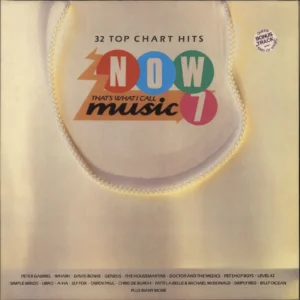
Happy 40th to my very 1st Now That’s What I Call Music album…
This is where I came in.
I’d seen past Now That’s What I Call Musics advertised on TV and displayed in shops. I remember wishing that I could get my mitts on one, since they seemed like the ideal way of snapping up the latest chart hit singles for a very reasonable price.
But I was thwarted on two counts. One, I didn’t get enough pocket money. And more crucially, even if I did manage to buy a Now, I didn’t have anything to play them on.
1986 was when it all changed though. Not only did my folks buy a brand new stack system hi-fi centre (you know the sort of thing I mean if you catch endless repeats of ’80s Catchphrase on Challenge or whatever – turntable, radio, tape player, equalizer, etc), that September I got my very first Walkman. Naturally, I needed a new tape to play on it, so there was only one logical candidate. I’d seen the advert for Now 7 on TV about a month before, so my poor parents were constantly subjected to demands of receiving the album as a birthday present.
With all that in mind, Now 7 holds a special place in my heart. Not just because it was the first of many Now That’s What I Call Musics that I owned (and I would become a Now Nut – frantically scouring the pages of Smash Hits to see when the next one would come out), but because it boasts one of the most interesting and extensive tracklists.
Where were we at Now-wise in 1986? A couple of years previous, the first Hits Album had come out, establishing dividing battle lines between labels. Which meant that as a rule, EMI, Virgin and Phonogram labels and offshoots couldn’t be used for Hits albums, while WEA, CBS and RCA were persona non grata for Now albums. However, this rule tended to be relaxed when there were no rival albums on the shelf. In Spring 1986, the very good Hits 4 allowed rival label acts into its club, resulting in rare appearances from the likes of Kate Bush, Diana Ross and – uh, Belouis Some.
To return the favour, Now 7 welcomed one and all into its giant paper bag of tricks. It includes a slew of WEA, CBS and RCA bands and singers for one of the last times this decade – if memory serves me well, Now 9 will take a similarly easy-going approach, but after 1987, the two clubs become exclusive again.
As for the music itself, for the most part, Now 7 stands up incredibly well 40 years on. It includes a healthy mix of familiar classics and underground obscurities. There are four Number Ones featured, although these work to varying degrees.
I remember my ears waiting in excitement at the first quiet sound effects of Track One, as that tape hissed through my Walkman headphones. What better way to usher in Now 7 than Peter Gabriel’s Sledgehammer? One of my favourites that year, in 2026, it still sounds as if it had been made yesterday. Having branched out from prog into other influences over the years, the solo Gabriel came up with a decidedly non-prog slab of blue-eyed soul that is guaranteed to put a smile on even the grumpiest of faces (Like mine). It helped that it was accompanied by an innovative and eye-catching stop-motion animated promo video, but even without the memorable visuals, Sledgehammer remains one of the jewels in Now 7’s crown.
UB40’s Sing Our Own Song is a worthy call to arms, providing equal helpings of dance and food for thought. The drum beat sound still sounds like a slowed-down crow cawing at the top of its voice, but this slimmed-down version from the Rat In The Kitchen LP sees the band in fine fettle.
The advantage of the Now series is that it captures lesser heard acts that fleetingly made it big at the time. One of those is duo, Sly Fox (Gary ‘Mudbone’ Cooper and Michael Camacho), who scored a huge hit with Let’s Go All The Way, an infectious pot pourri of new wave, dance and social commentary. Observing the whopping great gap between rich and poor in their native homeland, Let’s Go All The Way includes some classic turns of phrase “Living in New York, looks like an apple core (apple coooooore), asphalt jungle, got to be a man-of-war.” The beat’s a bit dated, but it’s still held its own very well.
By 1986, Level 42 had got their feet under the Now table, having previously popped up on Nows 4 and 6. One of their biggest hits, Lessons In Love, was an obvious choice for lucky 7, and while it doesn’t sound quite as modern as I thought it did at the time, I still have a soft spot for the ’42. Mind you, I thought that those lumbering, 50-ton computer monitors and keyboards in school were state of the art modern, so what did I know?
Whereas Level 42 had become part of the Now furniture, one act yet to make an impression was the Pet Shop Boys. Opportunities (Let’s Make Lots Of Money) is the first – but by no means the last – track of theirs to be featured on a Now compilation. While it’s not the duo’s biggest seller, I’ve always liked this sly takedown of crass ’80s monetary greed. The mix included here is the one I’m most familiar with, so it’s always been a mild annoyance when other compilations feature a different version.
But then not many compilations feature the last three tracks on Side One for me to worry about which mix they use. Pete Wylie’s goth opera melodrama Sinful carries on where The Mighty Wah left off – about the only thing I remember about this one is calling it Slinfold, because it was down the road from where I used to live.
If Slinfold’s a bit too histrionic for my liking, Camouflage is much more my cup of brown grit and water – a spooky ghost story from Stan Ridgway about the Vietnam War in which a quaking PFC is helped in his mission by “a big marine called Camouflage”, who had actually passed away the night before. The droll cowboy twang is brought to life by Ridgway’s vivid storytelling. I don’t think he had any more UK hits, which is too bad, but his lone hit remains memorable.
If I’d been greedy, saddo-12-year-old me would have wanted Now 7 to include a couple of novelty hits which I’d bought as singles – if only for completion’s sake. Alas, Spitting Image’s Chicken Song and Cliff Richard & The Young Ones’ Living Doll were nowhere to be found. But the nearest you could get to a novelty record is Max Headroom duetting with The Art Of Noise on the spooky insomnia of Paranoimia.
Perhaps Max should have listened to the first track on Side Two in order to get to sleep. Chris De Burgh’s sickly Lady In Red reached pole position that Summer, but as has been proven many a time, public demand doesn’t always equate with quality. A sappy ballad that’ll either get 70-somethings smooching on the dancefloor or have you reaching for the nearest sick bowl.
David Bowie’s Absolute Beginners would be up next – unless you have the reissued CD version, which omitted three tracks from the original. Rights issues, I’m guessing, but why did it have to be Bowie left off the roster and not the track before? Maybe a problem with Absolute Beginners is its unusual length, clocking in at nearly six minutes. It’s not vintage Bowie by a long shot, but it does feature a very strong vocal turn from the man himself over a sturdy musical beat.
Side Two’s line-up does cater more for the rock fan in your family, with Genesis up next. If, however, that rock fan is more of a prog purist, chances are, he or she won’t care so much for the comparatively poppy Invisible Touch – although I’ve always had a sneaking like for it. Simple Minds I was never so keen on at the time, but despite – again – its length, I quite like All The Things She Said. My mum used to think that Jim Kerr was a carbon copy of Bono, because he wore the same kind of hat in a promo video if memory serves me well. It’s a bit too earnest, but I’ll take this over the dreary Don’t You Forget About Me and equally lumpen Alive And Kicking any day of the week.
One of my favourites at the time on Now 7 was Happy Hour by The Housemartins, and this perky snatch of indie pop is a brilliantly biting attack on office drinking culture – “I think I might be happy if I wasn’t out with them” is one such early stinger. No wonder that they’d become one of my favourite bands in my teens. Another favourite at the time was Look Away by Big Country, a hard rocking first sample of The Seer. I’m still a fan of this one, especially the way the guitar goes from sparsely clipped phrasing in the verses to the full-blooded chorus. It packs an awful lot into its timeframe, and remains a favourite.
The lesser known Brilliant Mind by Furniture is another worthy find on the album. It’s one of the most haunting on Now 7, an atmospheric exercise in mood, building up from a sedate Jim Irvin croon to a smoky jazz club saxophone crescendo. I also really like the quiet final guitar pluck after the thing’s calmed down. It would have made for a better Side Two finale than the somewhat nondescript Call Of The Wild from Midge Ure, which is at least partly salvaged by some hefty drum thwacking in the fade-out.
Side Three is probably the most pop-oriented of the lot, with an emphasis on Smash Hits favourites. One of these acts was taking its final bow – Wham, who took listeners to The Edge Of Heaven. If it’s a bit similar in beat to Wake Me Up Before You Go Go, it’s still a decent parting shot – even if you think all the lyrics are going to run along the lines of “Yeah, yeah, yeah, yeah, yeah, yeah, yeaaaaaah, yeah.”
Certain ’80s acts suffer from being in the wrong place at the right time during a TV production gaffe. We’ll see All About Eve suffer this fate in six Nows time, but for now, here’s Owen Paul, who was famously left high and dry on an edition of Pebble Mill, missing his cue to mime along to My Favourite Waste Of Time. The track itself isn’t bad – even if the saxophone solo is a bit overwrought – but I hope that Paul’s Pebble Mill gaffe didn’t overshadow his chart success too much.
A trio of cover versions up next. One works, two of them don’t so much. It’s Amazulu who come out on top with their sprightly reading of The Chi-Lites’ Too Good To Be Forgotten. It sounds like they’re having fun, unlike the other two which sound like they’re merely going through the motions.
Doctor And The Medics caught the eye of record buyers on account of their memorable look. Frightwigs, copious amounts of eyeshadow, robes… and that was just the blokes. The problem is you can’t see all that novelty on a record, and on the evidence of my ears, their version of Norman Greenbaum’s Spirit In The Sky is mind-numbingly ordinary. They’d repeat the pattern with even more diminishing returns on their cover of ABBA’s Waterloo (see Now 8 witterings elsewhere on the blog), but by then, the public had got wise and consigned it to the dumper.
1986 marks the turning point in Bananarama’s career when they elected to become Stock Aitken And Waterman’s latest singing props. The problem is, all that enthusiasm and fun that they had in their early days has all but vanished. The trio sound bored on their cover of Shocking Blue’s Venus, intoning the lyrics with one eye on the music sheets and the other on the clock as the next cigarette break looms. All to the sounds of SAW’s Fisher Price boom box demo for toddlers.
Another act from the early ’80s was Bucks Fizz, although by Now 7, they’ve regenerated Jay Aston into Shelley Preston. New Beginning (Mamba Seyra) is a confident attempt at a comeback, with its heavy tribal drumming and exotic vocals. Alas, that confidence was a tad misplaced, as the hits dried up after the Top 10 success of New Beginning. I still quite like it, though.
Mrs B was delighted to see her favourites a-ha included on Now 7’s tracklist, and by 1986, they’d become the golden boys of the day. The title track of Hunting High And Low was the fourth release from that excellent album, and it’s been given a fresh gloss with genuine orchestra swings and redubbed drums. I don’t think they were ever comfortable with the pop star tag, and this ambitious ballad showcases just what they could do. Morten’s vocals are superb.
The balladry keeps a comin’ with Simply Red’s reflective weepie, Holding Back The Years. The older I get, the more I relate to the lyrics – and it’s also a vivid reminder of the golden age of sitcom, as Only Fools And Horses’ Del clutched wedding cake figures, while Rodney and Cassandra left him poignantly alone in the Nag’s Head special occasion room. I wish they could still make comedy like that these days, but telly big cheeses either can’t or won’t. Or both.
And as a special bonus, Queen’s A Kind Of Magic is included! I’m never quite sure why this was only included on Now 7 as a bonus track. A last-minute afterthought? A rights switcheroo? Either way, and whatever the reason, it’s a very welcome presence.
Kids at school watching TOTP in 1986 would always rename Billy Ocean’s When The Going Gets Tough (The Tough Get Going) “Go And Get Stuffed”. I’m not sure how that came about – part of me thinks that Noel Edmonds came up with this revelation on his Late Late Breakfast Show, but I could be wrong. Anyhow, it’s the last Number One to be included on the compilation, although there will be a few close shaves.
Side Four continues the generally high standards of Now 7 with a mix of dancey hits and more elusive cuts. Jaki Graham was at the peak of her popularity in 1986, and the strutting funk of Set Me Free remains her finest moment – even if one of her backing singers was trying to steal her thunder on TOTP with some Dawson-esque gurning at the cameras.
A favourite track of mine is Nu Shooz’s I Can’t Wait. Nu Shooz were Valerie Day and John Smith, a husband-and-wife duo, who came up with this eccentric dancefloor classic. The unconventional hook which repeats throughout sounds like a yapping dog – it shouldn’t work, but it does, and is just one of the many charms to be found on their excellent parent album, Poolside, which is well worth tracking down.
Two Side Four tracks go AWOL from the re-issued CD version, and one of these is the proto-rap Bang Zoom Let’s Go Go from The Real Roxanne featuring Hitman Howie Tee. I’m not rap’s greatest advocate by a long chalk, but I like the quirky ambience of Bang Zoom – there’s a childlike appeal in its choice of sampling old Bugs Bunny cartoons.
Much of Side Four is worth checking out, because a lot of those samey ’80s 100 Hits or whatever compilations tend to repeat themselves. A notable Now 7 curio is Lovebug Starski’s Amityville (The House On The Hill), a cod-horror rap storyteller, which contains amusingly ropey impersonations of Bela Lugosi, Captain Kirk and Mr Spock! Modern day autotune chart dreck has lost its sense of fun, so it’s nice to rediscover a time that wasn’t afraid to take itself too seriously.
Midnight Starr’s Headlines also comes from their most successful year, with Midas Touch doing even better in the late Summer of ’86 (it’ll be included on Now Dance ’86). Not one that immediately rolls off the tongue when reading the Now 7 tracklist, but stick with it – it’s got a killer of a melody and an instantly toe-tapping grooveline.
Depending on whether you have the CD, the tape or the vinyl, the last track is either Aurra’s You And Me Tonight – an argument set to agreeable ’80s club sounds – or Patti LaBelle’s and Michael McDonald’s weepie On My Own. The Aurra cut doesn’t have the same impact, fading out relatively quickly, while On My Own strings out the heartache till the bitter end, in what must surely be the longest fade-out in recorded history.
There you have it. My very first Now That’s What I Call Music, and despite my personal connection with it, it’s still one of my favourites of the long-running franchise. It contains something for everyone – pop, rock, rap, dance, funk, weepy ballad… you name it, it’s in the bag.
(Cover design credited to The Design Clinic, Janet Newmann, McCormicks and Andrew Moran)
If you liked this article, you might like some of my other books which are available to buy at Amazon:
Amazon.co.uk: JOHN BENSALHIA: books, biography, latest update
