
Welcome, readers of illusion to this castle of confusion. In the year ’26, I revisit ’87 and find 26 tokens relating to a classic CITV hit. Spellcasting! 2-6 M-E-M-O-R-A-B-L-E T-H-I-N-G-S A-B-O-U-T K-N-I-G-H-T-M-A-R-E!
Dungeon Doom
Despite starting on 7th September 1987, Knightmare’s genesis goes back two years previous. It was the brain-Child of Tim Child, who was said to have taken inspiration from two action adventure computer games called Atic Atac and Dragontorc. Child saw the potential of transferring the computer game trend to TV, and so set about devising the concept.
The key to realising this was through that bane of Doctor Who: CSO. Not only was CSO – or what you’d call Green Screen these days – used for Doctor Who and the like, it was used for other simpler telly tricks like weather and news reports in the ’80s. Knightmare was a little more advanced than this, running along the lines of that Doctor Who chestnut, Underworld, in which special effects, actors and lighting would be realised on a real-time basis.
Child’s team – including artist David Rowe and Robert Harris (the owner of the Travelling Matte Company which made the computer graphic locations) – set to work, and by early 1986, a 15-minute pilot called Dungeon Doom had been prepared. Hugo Myatt was also on board for both this first pilot and the second one which was made the following year. Dungeon Doom’s name was changed to Knightmare, and was sent to the big cheeses at ITV, who agreed to commission a run of eight episodes.
Fighting Fantasy Influence
As well as the mid-’80s vogue of computer games, role playing books were a notable trend of that decade. If, like me, you were one of those nerdy kids who grew up in the ’80s, the chances are, you might have bought the Fighting Fantasy books.
The Fighting Fantasy range was the brainchild of Ian Livingstone and Steve Jackson. They came up with the novel idea of making the reader the hero in their own adventure. Each of the books in the range gave the reader a quest to complete, which they could accomplish with the help of a pencil, an eraser and dice. You’d roll the dice to determine your levels of Skill, Stamina and Luck, and then as you’d progress through the book, you would either add to or detract from those numbers. The non-linear format of the books was a great innovation – the pages were divided into 400 sections, and at the end of each section, you would get the multiple choice of going to any of these mini-chapters numbered between one and 400. Depending on how lucky and savvy you were, you’d either win or fail in your mission, and if it was the latter option, chances are you’d fail with your life.
The trend and templates of the Fighting Fantasy books do remind me of Knightmare, which adopted the quest motif, as well as the medieval ambience of books such as The Warlock Of Firetop Mountain and The Citadel Of Chaos.
Welch Known
What better way to launch each episode than with those dizzy cartoon graphics of a knight attempting to reach the castle while battling orcs, trolls and other nasties? All to the sounds of that hummable Ed Welch theme tune, which certain forty and fifty-somethings could probably hum off by heart even to this day.

Halt, Hugo’s There
The inspired casting of Hugo Myatt as dungeon master, Treguard played a big part in the success of Knightmare. Prior to 1987, Myatt’s only previous brush with TV was in 1979, guesting in a programme called Park Ranger in which he played Reverend Bultitude. Knightmare, however, gave Myatt his big break. Using his eyes and voice to great effect, Myatt frequently stared boggle-eyed at the camera to all but hypnotise viewers into coming back next week.
Despite the cod-medieval trappings, Knightmare’s central character is required to fulfil the function of gameshow host, which takes some skill. Not only does Treguard guide contestants through their challenges, he has to provide links, display a certain level of empathy and humour – and also, improvise. A lot of Knightmare was apparently made up on the hoof, including Treguard’s frequent wince of “Ooh, nasty!” Myatt couldn’t ever have predicted what contestants would have done next, so he would be constantly thinking on his feet. That Myatt managed to make Treguard into such a memorable and popular character is testament to his acting genius.

In A Pickle
The fourth series added to the ranks of regulars with the introduction of elf, Pickle. Played by David Learner (Marvin The Paranoid Android in The Hitchhiker’s Guide To The Galaxy!), Pickle’s function was to act as a figure that the audience could identify with. Whereas Treguard could offer advice and caution, he couldn’t provide the extra help that characters such as Pickle – and then Majida could.
While I’m on the subject…
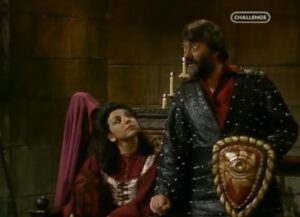
Ho, Ho, Ho, It’s Majida
Pickle returned to his forest in Series Seven. His replacement was the “Daughter of the Setting Moon Whose Eyes are Like Daggers in the Hearts of Men Who Ride the Great Caravan of the Sultan”.
Or Majida to her friends. This was Jackie Sawiris’ breakthrough role, and she would later go on to appear in the likes of Emmerdale, The Bill and Eyes Wide Shut. She would also go behind the camera to work as assistant director on The Mummy Returns and as production secretary on The Wire.
Out Of The Woodnutts
Doctor Who fans will enjoy seeing one or two familiar actors popping up in Knightmare.
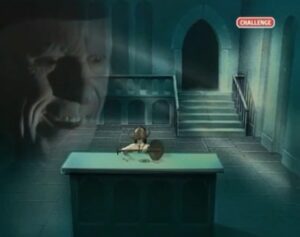
The most familiar is John Woodnutt, who appeared four times – Hibbert in Spearhead From Space, the Draconian Emperor in Frontier In Space, The Duke Of Forgill and Broton in Terror Of The Zygons, and Seron in The Keeper Of Traken.
Kids of a certain age will most likely recognise his face from the 1971 Look And Read adventure, The Boy From Space, in which he terrorised a generation of quaking schoolkids as The Thin Man. Woodnutt gets to showcase both sides of his repertoire in Knightmare as the good wizard Merlin, and his evil counterpart, Mogdred – again using his distinctive features to make a whole new generation of kids shudder in terror.

The Test Of The Hordriss
Another Doctor Who actor to appear in Knightmare was Clifford Norgate. He’d had the honour of providing the distinctive baritone of the Nimon and then two stories later, returned to provide the voice of the Generator in The Leisure Hive.
Norgate played the part of Hordriss The Confuser with relish. Hordriss looks like he’s been manufactured on a Blackpool pier, a human stick of rock with his white and red striped flowing locks. Like with many Knightmare characters, Hordiss blurs the lines between good and bad. At one point, he’s dangerous enough to have a team conjure up a sword spell to repel him. But as the series progresses, and he advances to the level of a wizard, he can become a force for good – even presenting winners with their trophies.
Who Goes There
Also from Doctor Who, Anthony Donovan briefly appeared in the elusive Space Pirates. He popped up in Knightmare as the shape-shifting Brollachan and the accompanying Quality Street Wrapper-clad wizard, Grimaldine.
If we really have to include NuWho, then David Verrey (the hammy Slitheen politician Joseph Green from the Aliens Of London two-parter) voiced wall demon Golgarach and played angry Celt warrior McGrew.

Familiar Faces
Away from the Doctor Who stable, some of the other players were familiar faces on TV. And continuing this blog’s Six Degrees Of Kevin Bacon trend, here comes Erin Geraghty again from Angels (in which she played Maureen ‘Mo’ Morahan). Erin plays Mistress Goody, a shabby old witch who claims to be “the hostess with the leastest”, but does seem to be the most conscientious broom sweeper in Knightmare history.
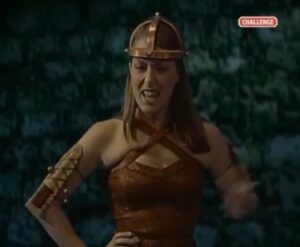
Elsewhere, Joanne Heywood – who had played Dilys in First Of The Summer Wine and Jessica Lovelock in Are You Being Served sequel, Grace And Favour – appears as feisty, knife-hurling warrior Stiletta during the series’ later run. Meanwhile, prolific extra Guy Standeven (who had turned up in every movie from Batman to A Fish Called Wanda) lent his voice to the two wall demons – one of whom is called…

Granite-Arse
The early days feature a slew of memorable foes and monsters, and one of the ones that stuck around was the snarling wall demon. These great big stone faces would challenge contestants with fiendishly tricky riddles. One of these was called Olgarth, another was called Igneous, while the most common one was Granitas, although kids at school spelt it Granite-Arse. The early wall demons look like they had just escaped from Sesame Street, but if questers messed with these wall demons of legend, they did so at their peril.

Ham Of Fear
One of the best-known baddies in the later run of Knightmare is Lord Fear (played by the appropriately named Mark Knight), the harbinger of doom who ousts Mogdred to become the main Big Bad of the show between 1991 and 1994.
A shadowy, sinister presence with a bacofoil-wrapped salad bowl on his head, Lord Fear is actually a bit of a lazy bastard – instead getting his boot-licking minions to do his dirty work. Skulking in his headquarters at his table – to the point where I expect him to start intoning Billy Joel’s We Didn’t Start The Fire – Fear barks commands and threats at underlings and opponents, but very rarely does he enter the dungeon.
I suppose, going back to those Fighting Fantasy books, he’s reminiscent of those elusive baddies such as the eponymous Warlock Of Firetop Mountain and Citadel Of Chaos sorcerer, Balthus Dire, who only appear in person for the final showdown.
The Sorceress Apprentice
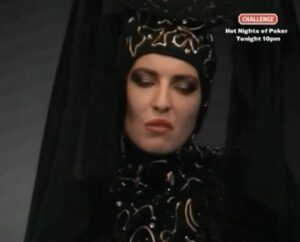
Knightmare also had its air share of sinister sorceresses. One of the most formidable was Morghanna (Natasha Pope), who helped to make the third season fiendishly tricky to complete. Twice does she get rid of two hopefuls – blasting one to atoms on the spot, and then using a magic axe to chop the ground from under another’s feet.
Lillith (Mary Miller) did the same thing. Questers would regularly find themselves at the entrance of the Serpent’s Mouth, which was guarded by Lillith, and if she was in a foul mood – frequently – they wouldn’t get any further, because she would crumble the ground with a mere wave of her hand, causing the contestant to plummet to his or her doom.

Ooh, Nasty
Apart from the cult BBC science quiz Brainstorm (in which contestants got ‘vapourised’ in a puff of dry ice), Knightmare is one of the very few gameshows that metaphorically bumps off its hopefuls.
And a kids’ gameshow, no less! In this kind of medieval fantasy quest, it makes logical sense to bring each attempt to an end by ‘killing’ the contestant. Knightmare does so in all kinds of gruesome fashion – falling down deep caverns… clobbered by grunting orcs… blown up by a giant time bomb… fried alive… eaten by a giant spider… The CGI effects take the edge off a bit, but for young kids tuning in, this must have been the stuff of nightmares.
And not helped by…
May The Life Force Be With You
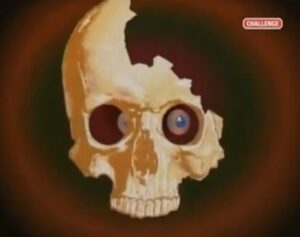
Each contestant is accompanied by a life force – an inset picture of a face. As the life force ebbs away, parts of the face fly off – so that when it’s at critical level, there’s nothing left but muscle, bone and googly eyes. If the life force runs out completely, the remaining skull flies towards the camera, leaving those two googly eyes doing a quick Can Can to the doomy sounds of a slowed-down heartbeat.
From Series Six, the life force representation changed to a generic full-length soldier, which would be gradually whittled down to a skeleton. Nowhere near as alarming for kids – instead, the final stage looks a bit comical, as the skeleton falls apart and clatters to the ground with an absurd clunk.

“Simon? Sidestep To Your Left!”
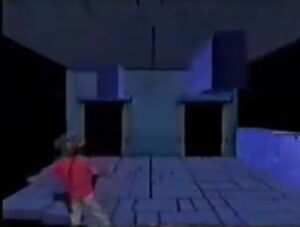
The most infamous goof in Knightmare comes from 1990, when Simon’s team come unstuck in the Block & Tackle room. Contestants couldn’t waste any time in this zone, as walls would slide back and forth, exits would randomly shift, and floors would crumble.
Mere seconds after Simon enters the room, a great chunk of floor disintegrates to his left. There’s still a good chance that Simon can make it if he runs to the right hand side of the room…
…But no. One of the team instructs with a totally straight face: “Simon? Sidestep to your left!” To which Simon plummets to his doom, as the skull and googly eyes are instantly superimposed over the hapless contestant’s faux pas.
The icing on the cake is actor David Learner attempting and failing miserably to hide his mirth by putting his hand over his mouth. Easily the show’s funniest moment, and one that’s haunted Simon and co ever since. Cheers, Internet!
On The Table
Technology changes, and one example is how the trio of contestants initially look at a treasure chest with a monitor screen and then in later series, a flatline table.
What would a modern-day remake come up with? Interactive iPads? A virtual reality revolving disc on the contestants’ eyeballs?
Nine Lives?
The 1994 season hadn’t performed badly by any means, so the question loomed: Would Knightmare get a ninth season? The last episode invites future contestants to write in and take part – but alas, the life force had run out for this cult classic.
Technology was evolving all the time, but the problem was, ITV couldn’t keep up with the costs. Short of spellcasting a lorry-full of gold bullion, there was no other choice but to swing the magic axe on this great programme.
Book Keeping
Seven books were published to tie in with the series. Written by Dave Morris, the books were a curious hybrid of fiction and interactive choose-your-own-adventure along the lines of the Fighting Fantasy books.
Like that series, readers still had to keep an eye on Life Force (rather than stamina levels) and also the items that they collected during their quest. The last volume, Lord Fear’s Domain, was a simple puzzle book.
Play The Game
In the days before kids became glued to their iPads and crappy TikTok videos, they used to amuse themselves with board games. The days of Mouse Trap, Cluedo and Guess Who reigned supreme, and joining those august toy shop ranks was the Knightmare board game in the early ’90s!
The box blurb challenges players to ascend to the throne of Merlin and find valuable treasures – all the while battling fiendish monsters and villains. You could do so with the help of a board, a castle wall and base, 56 cards, 52 tokens, four playing pieces and plastic bases apiece, dice and a riddle book!
As The Scarecrow Flies
Knightmare was so popular that it was even immortalised in song. A heavy metal band called Evil Scarecrow made Enter The Knightmare for their Galactic Hunt album in 2014. The lyrics covered all the familiar tropes connected with Knightmare, including the eye shield, wall demons, Lilith and Pickle.
Best of all, the band invited Hugo Myatt to contribute Treguard vocals on the track, which he agreed to do in his own, inimitable style.

YouTube Strikes
There’s no better medium for cancelled TV than the Tube Of You. The online platform held its very own Geek Week back in 2013, and as part of the celebrations, brought Knightmare back from the dead for a mini-special.
Impressively, it managed to bring back some of the major players. Hugo Myatt returned as Treguard, along with Mark Knight as Lord Fear and Cliff Barry as Lissard. Newcomers included Jessie Cave (Lavender Brown from Harry Potter) and Isy Suttie (Dobby from Peep Show). YouTube content creators braved the challenges, and tried their hardest to ensure that they didn’t sidestep to their left.
The Only Way Is On-Road
A live event of Knightmare came to the Edinburgh Festival Fringe in the Summer of 2013. Produced by Objective Talent Management, the shows were a success and starred Tom Bell, Paul Flannery and Amee Smith.
There are still Knightmare Live shows being performed independently around the country, continuing right now even as I type.
A Break With Convention
With many cult TV shows attracting conventions in their honour, perhaps it was inevitable that Knightmare would get this treatment.
And so it was in May 2014, when cast and crew attended a special Knightmare convention at EPIC Studios in Norwich. Visitors could learn how to design a dungeon room, have a bash at playing the game for themselves and then attend a Q&A panel with cast and crew. Attendees included Hugo Myatt, Tim Chlld, Mark Knight, and Iona Kennedy (who played both Sidriss and Greystagg).
Winners
There were seven winning teams in Knightmare. The first team to win was in Series Two (Mark, Daniel, Matthew and Jonathan from Witney), shortly followed in the same series by Banbury-based Julian, Vaughan, Becca and Mary.
The next victors wouldn’t appear until Series Five, when Ben, John, Ray and Jonathan from Exeter completed their quest. The following series, Ben, James, Alan and Nathan made it to the bitter end.
Series Seven boasted two winning teams – Julie, Samantha and two Helens from Staffordshire – and then ending that series on a high were Barry, Simon, Derek and Daniel. The final champions were Dunstan, Alan, Oliver and Alex from St Albans.
Prize Giving
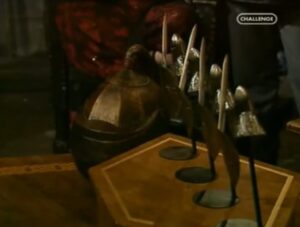
The coveted prizes were variables of trophies. In the earlier series, winners get the Silver Spurs of Squiredom – essentially a silver saucer that you could plonk a cup of tea on. Later series give winners Frightknight warrior statue figurines – which, along with the Silver Spurs, must be nowadays worth a fortune.
Plus, the Series Eight winners get to hang up in the Knightmare Hall Of Fame! There’s no greater prize than being immortalised in the Knightmare hall walls.
(Screengrabs credited to ITV, Anglia Television, Challenge TV, YouTube and EPIC Studios)
If you liked this article, you might like some of my other books which are available to buy at Amazon:
Amazon.co.uk: JOHN BENSALHIA: books, biography, latest update
