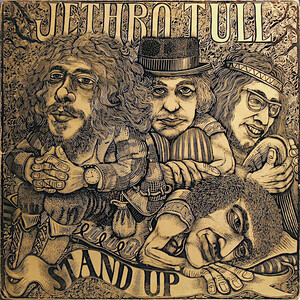
What a reason for waiting for a new blog post – a look back at the classic second Jethro Tull album…
A New Day Yesterday
Sundays were always a treat in my house when I was a little whiffersnapper. Sunday was always Record Day, when Mum and Dad would raid and play their vinyl collection. Me being me, I would scour every inch of these great platters, which included everything from The Beatles to Led Zeppelin.
One album that especially fascinated me was Jethro Tull’s Stand Up – primarily because of the unusual gatefold cover art. Stand Up did exactly what it said on the tin. Open up the gatefold sleeve, and a cut-out of the band would pop up like a children’s storybook. The striking front cover was the work of a woodcarver called James Grashow, who was asked to design wood carving style drawing depictions of the band. It’s one of the most eye-catching record covers of its time – and before you ask, I refuse to use that wretched word, iconic. Everything’s iconic these days – even a Sainsbury’s egg and pickle sandwich.
A New Day Yesterday itself picks up where previous album This Was left off, providing a chugging fusion of heavy blues and jazz. Much as original guitarist Mick Abrahams would have been delighted with this, frontman Ian Anderson wanted to push the boat out into other musical avenues. This clash of musical visions resulted in Abrahams’ departure, with Martin Barre stepping in to the breach.
One of the heaviest cuts on Stand Up, A New Day Yesterday powers through its verses with a recurring ascending bass/guitar riff – only taking a breather for the jazzy flute instrumental interlude. The notable guitar work from Barre was given an extra boost by engineer Andy Johns, who had a reputation for trying out innovative ideas and techniques. To achieve that stereo-leapfrogging effect, Johns used a simple – if risky – technique, which was to take a somewhat pricey Neumann U67 microphone, and swing it around the studio on its cable.
Apparently, no microphones were harmed in the making of this record.
Jeffrey Goes To Leicester Square
Who is Jeffrey?
This is one of the many mysteries circling the enigmatic second track on Stand Up. Your Starter For 10 answer is future Tull bassist and good friend of Ian Anderson’s, Jeffrey Hammond. He’d play with the band between 1971 and 1975, performing on the likes of Aqualung and Thick As A Brick.
Although why he referred to himself as Jeffrey Hammond-Hammond is another puzzler. I’m thinking of calling myself John Bensalhia-Bensalhia, if only to gauge people’s confused reactions.
To add to the confusion, why call it Jeffrey Goes To Leicester Square? The lyrics seem to revolve around Anderson swatting away the interests of a “Bright City Woman”. “You may be someone’s, but you won’t be mine,” he huffs. A recounted experience told to Anderson by Hammond? Or did Jeffrey’s name simply sound like a good substitute? Ian Goes To Leicester Square sounds positively mundane.
All very mysterious. But the gentle balalaika-bongo-flute combination is a treat, and is a good instance of the band treading other musical paths. One of the best on the album.
Bourée
Back to Bach, Jethro Tull take inspiration from Johann Sebastian’s classic lute work, Bourrée In E Minor. Choice factoid of the day is that a Bourrée was a popular kind of social dance in France, one that proved especially popular during Louis XIV’s reign. Remember that if ever your friend wants some extra phone help reaching a million on Who Wants To Be A Millionaire.
The Tull instrumental version leads with the first eight bars from Bach’s work, and features sterling bass work from Glenn Cornick and a flute tour-de-force from Anderson, who sounds as if he’s going to spontaneously combust on the spot by the track’s end, because of the sheer effort that he’s putting in to making this a timeless classic.
Back To The Family
A fair chunk of Stand Up is said to have been inspired by Anderson’s own personal experiences, with Back To The Family based on both the pressures of fame and his relationship with his own folks.
The lyrics seem to deal with this ‘Can’t-Live-With-Can’t-Live-Without’ approach to both. After receiving a rude phone awakening, Anderson says he thinks he’ll go back to the family “where no one can ring me at all.” And yet later, after visiting his family, he’s hankering to get back to the city after “that soft life is getting me down”.
And as a completely irrelevant aside, it makes me chuckle the way in which Anderson pronounces family as “fam-eee-leee”. He sounds a bit like a chap I used to do gardening work for many moons ago. Denny his name was, a 367-year-old shrivelled prune, who would used to ominously stand behind me while I was raking leaves. There was another kid who used to work for him called Lee, and Denny’s own unique way of yelling “LEE!” sounds uncannily like Anderson’s unusual way of pronouncing family.
Look Into The Sun
A mellow way of rounding off Side One, this pleasant acoustic ballad ranks among Stand Up’s finest. Martin Barre’s evocative guitar work isn’t too obtrusive, as Ian Anderson delivers one of his best vocal performances on the album. In fact, this is pretty much all Ian’s show, providing most of the instrumentation – although an uncredited Andy Johns is on bass duties as Glenn Cornick was AWOL that day.
Like many contemporary artists of the time though, Jethro Tull resisted including hit singles on their LP’s. I only mention this because their 1969 super-hit Living In The Past would also have made a good Side One closer. As it turned out, the track would only materialise on compilations such as 1976’s M.U. and – uh… Living In The Past!
Nothing Is Easy
One of M.U.’s most memorable choice cuts is its parting shot, Nothing Is Easy – one of two culled from Stand Up. More jazz-oriented in its approach, Nothing Is Easy fits in with the trend adopted by the likes of Chicago and Blood, Sweat And Tears for mixing jazzy woodwind and/or brass and good-time rock.
I like the way in which the track generously spotlights each of the players, especially Bunker’s frantic drumming and Barre’s outstanding electric guitar work. And for this anxiety-ridden chap who worries at the slightest thing (I worry when there’s nothing to worry about), the reassuring lyrics are a tonic. “Worse things happen at sea,” chuckles Anderson. “There’s good times to be had.”
Fat Man
I don’t think this is dedicated to me. I used to be as skinny as a rake when I was a youngster, but then middle age spread got the better of me – at least until this year, when I pushed myself to a regime of only eating guinea pig food, daily walks and daily sets of 100 press-ups.
Move over JanePlan, I can fit back into my old jeans again. Hurrah!
Apparently, Anderson wrote this about departing guitarist Abrahams. The poor sod couldn’t catch a break, it seems – even if Anderson insisted that he didn’t mean any malice by it. Mind you, imagine the reaction if this was released today in today’s overly sanitised climate. There’d be mass protests and shaking of fists on social media before you can say cream cakes. It’s a bit of throwaway fluff – not intended for deep and meaningful debates. The Eastern-sounding ambience (especially the rhythmic percussion) marks this out though, as does the interesting choice of mandolin which drives the track throughout.
We Used To Know
Question. What do Jethro Tull and The Eagles have in common?
Answer. Not only did they tour together in the early ’70s, but there are some schools of thought that allege that the Eagles subconsciously “borrowed” the framework of Tull’s We Used To Know for their super-smash Hotel California. It’s not something I’d noticed until now, and I’m kicking myself for not noticing this before. Not that Anderson minded anyways, as when pressed on the subject in 2016, he said that Hotel California was “much better” than We Used To Know.
Whether Tull purists would agree is anyone’s guess. The lyrics recall those early days of hard times before the band hit the big time. “Remembering mornings, shillings spent,” muses Ian. “Made no sense to leave the bed.” Fortunately, “fruitful years” were just around the corner.
Reasons For Waiting
An orchestral sheen adds extra welly to the penultimate track, a charming love song – even if Anderson himself claimed that he wasn’t entirely comfortable with writing conventional love songs.
For a man who supposedly finds a love song as easy a fit as a tight wellington boot, Anderson does a superlative job with this one. In a deluxe version of Stand Up, he wrote some thoughts on the tracks, noting that Reasons For Waiting took inspiration from those who were separated from their loved ones, whether at college, work or even war. “The memory stays clear with the song that you hear,” he yearns, before the strings kick into gear. It’s the sort of track that you could use in a big screen love story without sounding out of place.
For A Thousand Mothers
For A Thousand Mothers returns the album full circle to the opening heavy blues style of A New Day Yesterday. It does so via the route of Back To The Family, as Ian sings about how his folks questioned his decision to make money in a rock band rather than settling for the mundane nine-to-five. “It was they who were wrong, and for them, here’s a song,” he defiantly sneers. Being picked up at eight in a limousine isn’t the sort of thing that would happen while stacking shelves in a supermarket.
Musically, the final track runs along the same lines as the first, running full pelt to only breathe for quick gasps of flute. A neat trick that the Tull play is to make the listener think that the track’s finished. It all builds up to a big crescendo of drum, guitar and manic flute – all of which cuts off abruptly… before a tinkle of cymbal sneaks in again, to start the whole shebang off again, and fade the musical maelstrom into the ether.
Stand Up vindicated Ian Anderson’s decision to branch out beyond heavy blues rock and try out other musical genres. It was an immediate success, racing to the top of the UK album charts in September 1969. Worldwide, it was also extremely popular, breaking the Top 5 in Denmark, Holland, Finland, Germany and Norway. With a more eclectic palette to draw from, Jethro Tull turned in one of their very best albums – and while nostalgia may be influencing my thinking, this is one of my go-to Jethro Tull albums.
(Cover art credited to James Grashow)
If you liked this article, you might like some of my other books which are available to buy at Amazon:
Amazon.co.uk: JOHN BENSALHIA: books, biography, latest update
