55 years ago, the BBC boldly went where no TV channel had gone before.
Three weeks after Patrick Troughton’s Doctor had spun off into the ether, sci-fi fans could now enjoy another big hitter. Ironically, Star Trek’s original run had finished in America the previous month. But for British viewers, the space voyage of a lifetime was about to begin.
Star Trek would be repeated on the BBC countless times over the next few decades. I came aboard 40 years ago, when the Beeb began a fresh run of repeats from beginning to end (albeit with one or two Series Three episodes missing on grounds of them being a bit too much for a teatime audience).
While I never became as big a fan of Star Trek as I did with Doctor Who, I was still dedicated enough to collect all 12 of the James Blish adaptation books. I have fond memories of those excellent Chris Achilleos illustrations, as I frantically scurried around bookshops to collect the complete dozen. That eighth volume proved to be the most elusive, taking about two years to get.
I couldn’t quote a Star Trek episode word for word, like I do with Doctor Who. I couldn’t give you a complete list of cast, crew, trivia, etc. But I do enjoy the antics of Kirk, Spock, McCoy and the rest of the Enterprise crew. I used to tune in to the Horror Channel repeats a few years ago, and basked in the nostalgia once more.
Here are my personal favourites. I’m sure many of them will horrify and appal most ardent fans, who would probably phaser me out of existence. But anyway – my blog, my rules. Most of them are based on pure nostalgia and happy memories of scoffing supper while being glued to the screen in the mid-80s. So without further ado, let’s breach the final frontier!
Or my final 10 anyway. Which are in no order but chronological.
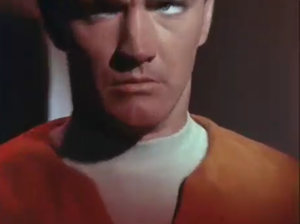
Charlie X
He’s not a Twitter salesman. Although the kid who beams aboard is a bit of a wind-up troll. Plus, anyone who dares to disagree with him or make fun of him suffers Charlie’s wrath. Sound familiar?
To be fair, Charlie is played by a guy who’s in his mid-20s. Although Robert Walker is great casting – by turns sinister and vulnerable. He’s a classic example of an out of control manchild. The thing I remember most about this episode is that weird thing he does with his eyes when he gets mad. He does this strange rapid eyeball raise, so that all you can see are the whites of his eyes. A lot of these picks are ones that I recall fondly from my childhood, and this was one of my favourites.
It’s got its fair share of memorable images – Charlie exacts his revenge in all sorts of macabre ways. Crewmembers are turned into lizards, aged to old codgers, and have their faces removed. Even the strange green Thasian face at the end is a striking image that stuck in the mind.

Space Seed
At the time, Space Seed functioned as a good bit of escapist space-based hokum. These days, given the 1982 movie, it functions as a prologue to what became my favourite of the Star Trek big screen outings.
Star Trek would be blessed with some great guest actors, but one of the best is Ricardo Montalban as Khan Noonien Singh, leader of a bunch of genetically engineered folks. Like all good villain actors, Montalban underplays his lines. OTT panto villainy has its place – sometimes – but there’s more to be said for a creepy baddie who is more controlled and calculated. It’s much more threatening than shouty ranting and raving.
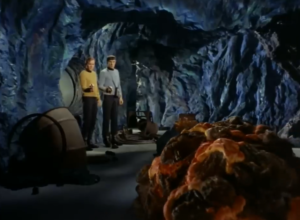
The Devil In The Dark
This is a good old-fashioned monster story that is bursting at the seams with all the usual horror movie trappings. Dark caves. Charred corpses. Scary monsters. But like all good Star Trek episodes, nothing is what it seems.
Because as Spock does one of his frequent mind-melds, he discovers that there’s much more to this so-called wrong ‘un than meets the eye. It’s a neat bit of blind-siding and a sign of growing confidence in the production team. This was an episode that was late in the run of the fledgling season, and by now, there’s a feeling that everyone had hit their stride, settling in to a comfy groove.
Joseph Pevney’s moody direction adds much to the atmosphere of this episode, and another plus point is that it gives the main trio of regulars plenty to do. Kirk gets to be the hero. Spock uses his brainpower to help solve the problem. McCoy gets to snark a lot.
This is an episode that you Horta see. But in a season that’s getting better all the time, another one comes along and steals its crown.

The City On The Edge Of Forever
An all-time classic, City is guaranteed to appeal to Doctor Who fans because the plot hinges on time travel. To be precise, a fixed moment in history is suddenly altered thanks to Bones. It’s changed to such an extent that it’s caused the Federation Of Planets to wink out of existence.
What also adds to the appeal is that it caters to all tastes. As well as some cool sci-fi time travel concepts, City also plays out as both a light comedy (the reaction of 20th century grunts at Spock’s ears) and a tragic love story.
The familiar trope of Kirk’s romances will wear thinner than his wig, but in this case, it’s perfectly in context. He makes the mistake of falling for Edith Keeler (Joan Collins), a character who seems to have it all: looks, charm, niceties (Edith doesn’t just run a soup kitchen, she also takes Kirk and Spock at face value, taking them in). Harlan Ellison’s intricately detailed plot steers the story to its inevitable tragic conclusion, and does it so well. It’s not overdone. There’s no OTT weeping and wailing, no OTT orchestras and choirs – which makes the conclusion all the more effective.
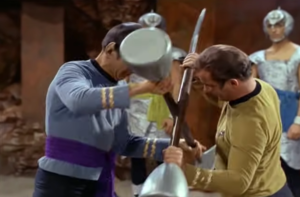
Amok Time
I vaguely remember a Star Trek documentary being on TV in the mid-80s. It may well have been an introduction to the repeat run of 1984. Leonard Nimoy linked a series of clips with some personal recollections and thoughts. What I remember is an extended sequence on Amok Time – naturally, given that plot revolves around the logical Vulcan – in which Nimoy discussed his fondness for the episode.
Making Spock behave out of character had been toyed with a couple of times in the first series (This Side Of Paradise, for example), but its taken one step further here. Rather than an alien influence being the cause, in this episode, Spock’s mood swings and uncharacteristic behaviour is all on Vulcan genetics. Vulcan adult males experience what’s called pon farr – which means that Spock must either find a mate or croak it.
Given that Spock had been one of the breakout successes of the first season, it was logical that the production team would explore his backstory. It’s a good hook to kick off the second season with a visit to Vulcan, and while modern day viewers may scoff at the studio-bound limitations of the planet, it does largely live up to the promise.
This is one for Trekkies as it includes the first example of the Vulcan salute, an appearance of T’Pau who’s not giving one inch of heart and soul, and also Spock and Kirk in a battle to the death with futuristic canoe paddles.
Mirror, Mirror
An obvious narrative trick, but realised with such relish that it’s hard to resist.
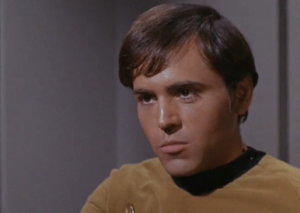
After Evil Kirk in the previous season (The Enemy Within), here we go with the parallel versions of Spock (complete with goatee beard), Chekov and Sulu. Spock’s Vulcan aloofness marks out his alternative self, while Chekov and Sulu get to be sadistic versions of their more benign selves.
But like his alternative real world counterpart, Chekov still screams like a little girl when he’s shoved in The Phone Booth Of Doom.
The cast are clearly having fun, and while it doesn’t quite reach the heights that Doctor Who’s Inferno would reach, this is still a fine example of the parallel world storyline.
The Doomsday Machine
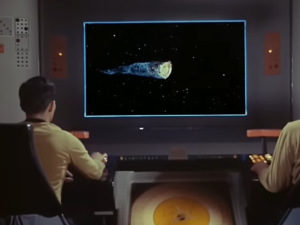
A giant pilchard doesn’t sound like the scariest thing in the galaxy, but thanks to the cast and crew of The Doomsday Machine, it’s given some extra welly.
Two things in particular mark out the fear. The first is William Windom’s bravura performance as Matt Decker, a man teetering on the edge after becoming the lone survivor of his crew. Star Trek doesn’t go for the psychological horror that often, but Windom’s crazed mania sells the threat perfectly. His own pointless self-sacrifice is a memorably jarring moment.
The other aspect is Sol Kaplan’s score. It’s a brassy, piano-driven piece of music that uses its heartbeat-like rhythm to ramp up the fear factor. It’s dramatic without being too OTT and in-your-face (Murray Gold could learn something from this), and functions as a pre-Jaws tension klaxon.
The Doomsday Machine has everything you could want in a Star Trek episode – from time to time, it may be a campy bit of nonsense, but when it feels like it, it can do hard sci-fi horror incredibly well.
Wolf In The Fold
Some elements of this haven’t aged particularly well. Like why does the evil entity only bump off females? Why do the supporting female characters get a maximum of two lines?
This is a piece that’s very much of its time. But for me, the combination of horror and whodunnit holds out much appeal. Robert Bloch was well known for writing psychological horror and fantasy, and he brought his own distinctive brand of terror to Star Trek twice. Catspaw nearly made the list, but this one just nudges ahead because of its spooky atmosphere, and also because it’s a murder mystery of sorts. The three people who have read by inane burblings might recall that I’m a massive fan of this genre, and it works well here.
Of course, anyone with half a brain (which rules me out) can work out that Scotty isn’t the killer. Plus, anyone with half a brain can work out who the killer actually is. Rule number one: look to the character who constantly points the finger and protests when the accusation against the scapegoat is contested.
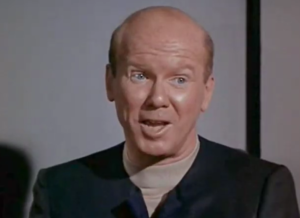
Wolf In The Fold also deals with some interesting concepts, such as the notion of an intangible evil that’s been around since the dawn of time. It’s realised quite eerily too, thanks to John Fiedler’s manic vocal performance.
As Hengist would squeak in the above pic, “Well, this is fantasy!” It is. Dark fantasy, but for this horror and whodunnit fan, it’s my poison.
And The Children Shall Lead
OK. Hear me out…
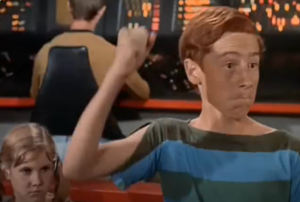
And The Children Shall Lead is ridiculous. Everything that could go wrong does go wrong. A bunch of kids summon an alien who turns out to be a tubby bloke in a mumu. Said kids discreetly stroll around the Enterprise while making dubious fist pumping movements that make the crew go insane in different ways. Shatner displays an awesome level of ham when under the control of lead kid, Tommy. Kirk saves the day by making the kids cry. It’s car wreckage telly, pure and simple.
But as a bit of light relief, it’s unbeatable. If you have a bad day, hop on the sofa, pop this episode on the DVD or Blu-ray player, and I guarantee you’ll laugh your head off. The idea that the Enterprise crew could be at the mercy of a man in a psychedelic poncho is laughable. It’s even more absurd that Gorgan is played by then-hotshot lawyer, Melvin Belli, who’s guilty on all counts of a terrible performance that’s delivered in a relentlessly flat monotone.
The jerky fast zoom-ins into the kids doing those unintentionally funny fist pumps is matched by some of the characters’ biggest fears. Sulu imagines flying swords in space. Uhura cowers away from her reflection as an old lady – complete in a magic mirror that appears at her console from out of nowhere.
Plus, there’s William Shatner. In a season full of OTT turns, this is one of his finest moments as he staggers around, boggle-eyed and crazed. In the elevator as he fears that he’s losing control of his ship. The only way he can save the day is to show the kids stark footage of their late folks. And then after Belli has been turned into an overcooked pizza, McCoy comes in, beaming at the fact that Kirk has made the youngsters cry!
It’s earned its place as one of the all-time turkeys. But for me, it never fails to make me laugh with its clumsy unintentional goofiness.
Spectre Of The Gun
Season Three was where it all went to pot. After two largely quality seasons, the third one’s the bad luck charm. Too many episodes either tread water or are too laughable to be credible. It’s a season that opens with the Enterprise crew walking around wearing day-glo bum bags while seeking a lobotomised Spock.
Spectre Of The Gun does manage to claw back some dignity. It’s stagy for sure, but deliberately so. Much as I loathe Westerns, I like the strange, surreal quality of the OK Corral set-up. It plays out like a nightmare in which time jumps around, characters vanish, and our heroes are backed into a corner. It’s that unsettling bad dream feel that gives this Season Three example a bit more of an edge.
(Screengrabs credited to CBS Studios/Paramount Pictures)
