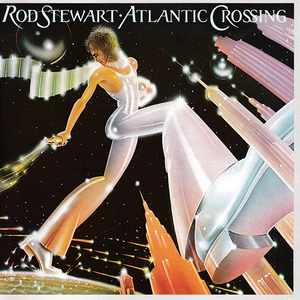
Stormy waters ahead for Rod’s big blockbuster album from this day in ’75…
Three Time Loser
Atlantic Crossing is one of those rare albums which somehow turned up like a proverbial bad penny in my collection.
It’s a shame. Rod Stewart’s first five LPs have loads to recommend them. Every Picture Tells A Story and Never A Dull Moment are superb. The lesser known An Old Raincoat Won’t Ever Let You Down and Gasoline Alley are great. I can even find good points in the lesser regarded Smiler.
The first time I walked away with Atlantic Crossing in early 1994, the local library tape shop was doing a deal in which you could buy a select number of used tapes and get one free. The freebie just happened to be Rod’s 1975 juggernaut LP. I don’t think I was especially impressed when I heard it, so I wasn’t too bothered when the tape later got chewed up and spat out like half-eaten spaghetti.
The second time, in Summer 2011, a local charity shop had a pile of those freebie CDs that you’d get in the national rag. I think there was Parallel Lines by Blondie, Searching For The Young Soul Rebels by Dexy’s Midnight Runners and No Parlez by Paul Young. Plus, Atlantic Crossing.
What the hell, I said to myself. They were only 10p each. Maybe I might like Atlantic Crossing a bit more this time around. As it turned out, I didn’t mind it as much as I did all those years ago, but it’s still not as easy an album to get on with as the others that I’ve blogged about so far. But what’s a blog without balance? Sometimes you need a bit of critique. There are only so many ways in which you can say that something’s good. Besides, it’s a Monday morning on which I’m typing up this latest bit of nonsense. No one’s in a good mood on Mondays.
So what’s my problem with Atlantic Crossing? A number of things, which I’ll burble about through these 10 tracks. A chief issue is that it feels like a comedown after Rod’s early album run. His first five albums feel that much more genuine, more real. After the comparative commercial failure of 1974’s Smiler (which is still more enjoyable than this), Rod switched labels to Warner Bros, and in an attempt to win over new listeners, introduced a glossier kind of sound. He called on the cream of American sessionerati such as Steve Cropper, Donald ‘Duck’ Dunn and Booker T Jones, as well as new producer Tom Dowd to add a trendier sheen to proceedings.
Commercially, the ploy worked, as the resulting album became a massive hit. Critically, I’m not so sure. It’s too corporate and clinical for my liking, and it’s instantly apparent on Three Time Loser. A seedy tale of a bloke who’s being constantly messed about by his missus, the tune needs a bit more oomph to create an impact. It’s catchy enough, the girly chorus should stick around in the thinktank after a couple of spins… but where’s the life?
As it is, this mid-groove plodder leaves the heavy lifting to the lyrics to make an impact. The problem is, these days, it’s the wrong sort of impact. In no uncertain terms, the loser’s other half makes moves on other blokes, has left the hapless loser with – er – an unwelcome medical problem, and has caused him to spend too much time alone with dirty books. I’m sure the album opener’s attempting to be funny, but instead, it’s come out in the wash as a bit grubby…
Alright For An Hour
One of the better efforts on Atlantic Crossing, this has a bit more urgency to it, a reggae-tasting shuffle that moves at quite a clip. Keeping up with the disco trends of the mid-’70s, Rod turns in a credible slab of reggae-style dancefloor. I like the ’70s sounding keyboards in the middle bit from either or both Barry Beckett and Albhy Galuten, and also that brief guitar chord descending between the last salvo of chorus repeats.
See, I’d previously assumed that Rod hadn’t had much writing input on this album, but actually, fair do’s, he gets writing credits on half the tracks. This one and another one on the flip side are up to his previous songwriting standards – even if they’re not the selections that fans tend to talk about.
All In The Name Of Rock ‘n’ Roll
This and Stone Cold Sober are the closest that you get to the original style of Rod’s music. They could have slotted in to Every Picture Tells A Story or Never A Dull Moment, and no one would have batted an eyelid. The only tell-tale signs are the sleeker production values, which depending on where you stand, boost or hamper the tracks’ fortunes.
It’s a passable five minutes of pub rock. You can almost smell the sawdust, tobacco and Jack Daniels as soon as you play it. This is probably as fast as you’ll get though on what was originally called the ‘Fast Side’. Or in other words, mid-pace. Rod’s shot himself in the foot by dividing the album up like this for a number of reasons – one of which is that none of the tracks on the so-called Fast Side are particularly fast. There’s not one moment when you think that the players have broken the speed of light.
This problem comes unstuck all the more when Rod tries to get clever with his lyrics by name-checking other contemporary groups and singers. “Listen McCartney,” he snorts at one stage. “We’re the Band On The Run.” Band On The Run? Huh. More like Band On The Leisurely Stroll.
Drift Away
Damning with faint praise, the best compliment I can give Rod’s take on Drift Away is that it’s not the heinous Michael Bolton version, which is the aural equivalent of having dog poo syringed into your ears.
Rod was no stranger to cover versions, having tackled interpretations originally played by everyone from Jimi Hendrix to Aretha Franklin. For this one, he’s mining a Mentor Williams standard, which would be made famous by Dobie Gray, and more obscurely by Mike Berry – best known as Mr Spooner in Are You Being Served.
It’s pleasant enough, Rod’s version – nowhere near as good as Gray’s reading – but pleasant. Again, though, where’s the fast? It tootles along at a sedate rate, with lots of groovy bongo work thrown in for good measure. But fast this is not. The only signs of life are when Rod repeatedly croaks “Can ya help meee?” towards the song’s climax, as if he’s trying to ward off a swarm of attacking bees in the recording studio.
Stone Cold Sober
Back in the days of the humble cassette, record companies would often rearrange the running order of songs in order to level up each side’s playing time. Sometimes, the original order of one side would either be far longer or shorter than the other, leaving a whopping amount of tape hiss to get through before you swapped it around in the player.
Which is what happened with my original copy of Atlantic Crossing. Stone Cold Sober played musical chairs with the penultimate track on Side Two, Still Love You – in the process, making a whole mockery of the original concept of Fast and Slow. If I was being cynical – and I am – I’d say that the presence of Stone Cold Sober might actually wake up the original running order of Side Two, so maybe the swap wasn’t such a bad idea.
Again, like the majority of Atlantic Crossing’s high points, this is competent rather than great. It’s competently played, competently sung pub rock, but it never quite wants to reach for greatness. Having said that, there is one attempt at doing something a bit unusual on Stone Cold Sober – which is to play the ‘You think it’s finished, but it hasn’t, actually’ trick. Hurrah!
I Don’t Want To Talk About It
I wasn’t a stranger to the first three tracks on the Slow Side, since I’d heard them in different guises here and there over the years. Surprisingly, the first I’d heard of I Don’t Want To Talk About It was the Everything But The Girl version in 1988. My folks weren’t especially big Rod Stewart fans – they did buy his Greatest Hits album in 1991, but in my childhood days, he was notably absent from my parents’ turntable.
I like Rod’s version, though. Rod’s frail warble is the perfect fit for this Danny Whitten tale of woe, and the arrangement’s nicely done – initially a simple acoustic guitar, and then a sweeping crescendo of strings, courtesy of Arif Mardin and James Mitchell. Unlike most of the other stuff on offer here, Rod actually sounds invested in the material, and turns in one of his best vocal performances.
The public liked it enough to give Rod his second number one from this album a couple of years later. Released as a budget double A-side with The First Cut Is The Deepest (from A Night On The Town album), it held court at the top of the charts in the Spring and early Summer of 1977. Some naysayers have implied that the success of the double A-side was a deliberate ploy to keep The Sex Pistols’ God Save The Queen from the Number One spot at the time of Mrs Maj’s jubilee. Whether or not you go along with this theory is up to you, but there’s no denying the fragile staying power of this one. The best on the album.
It’s Not The Spotlight
My initiation of It’s Not The Spotlight came at the age of four when Mum got a copy of The Manhattan Transfer’s excellent Pastiche album for her birthday in 1978 (And look out for The Manhattan Transfer, they’re due for the track-by-track album treatment in a few days).
It’s Not The Spotlight, Manhattan Transfer-style, is a tour-de-force. A dramatic, driving bit of soul, played and sung with great panache, and featuring a superb vocal turn from Janis Siegel, it’s one of the many high-points of Pastiche.
It’s Not The Spotlight, Rod Stewart-style is a damp squib that has all the passion of a pair of false teeth in a glass of liquid. That’s the problem with hearing another version of a track that you know – very rarely does it live up to the promise. Rod’s version moves at a glacial pace, and what’s incredible is that the session players on this would be rehired for The Manhattan Transfer version. They must have been downing the energy drinks a couple of years later.
In an attempt to recall Rod’s glory days, the mandolins are brought on, but even this nostalgia can’t save it. I know this is the Slow Side, but Rod-style It’s Not The Spotlight takes this concept to the absolute extreme.
This Old Heart Of Mine
The third track that I’d heard before, and funnily enough, it was done by Rod himself. In 1989, as a taster for his latest Greatest Hits package, Rod souped up this Isley Brothers classic by inviting its original singer to come and duet with him. Ronald Isley provides some typically thrilling vocals, and Rod is inspired enough to raise his game. The production is lavish, with strings, horns, percussion, and plenty of female backing warbling. It was always on the radio in the Winter of ’89, and when my folks bought the Greatest Hits album, I knew it pretty much off by heart.
So imagine my bafflement when buying the tape in 1994. To say that the 1975 version is muted by comparison is an understatement. It limps along like a three-legged horse attempting to pull a juggernaut. To divide tracks between “fast” (or fast-ish, any rate) and “slow” was a terrible mistake, and one that badly hampers Atlantic Crossing. There’s no room for variety when you try this tack, and Rod hadn’t learnt his lesson the following year, when he did the same thing for A Night On The Town – albeit the other way round.
It did OK in the charts, though (whereas the 1989 version didn’t fare so well). It reached the Top 10 in the UK – although that was maybe on the back of the success of that dreaded Number One hit he’d just had, which is coming up in a couple of tracks’ time. It has a really distracting vocal backing too, with one of the singers screaming the chorus in a really high pitch that only dogs can hear.
Still Love You
The main beef I have with Atlantic Crossing is its cynically corporate feel. It’s all very well assembling a crack squad of session musicians, but what’s the point when the vital passion’s missing? There’s no spark, no urgency, no humour either – to be honest, I even prefer the much-maligned Blondes Have More Fun, which is at least so outrageous in its strutting ridiculousness that it makes me laugh. Atlantic Crossing, by comparison, for the most part, is a soulless experience.
But at least on Still Love You, Rod does attempt to let his guard down. Along with the side opener, this is as good as this album gets, a genuine love song with a nice bit of wry humour creeping in: “All I’m tryin’ to say in my awkward way is ‘I still love you’” he rasps in the chorus. I wish he’d shown that same sort of likeable self-deprecation a lot more on this album.
Sailing
Uh oh.
I don’t want to talk about Sailing and how it broke my patience. I’ll just say it’s one of my least-favourite records: a ghastly, funereal dirge that’s hobbled further by what sounds like some evil cult chanting away in the background.
For whatever reason, it reached Number One in Autumn 1975, and returned to the Top 5 the following year when it was used in the accompanying BBC documentary series, Sailor. The UK public obviously couldn’t get enough of it – nor the accompanying album, which also hit Number One during a 90-week run. Atlantic Crossing also attained pole position in New Zealand and Norway, and did the Top 10 business in the US, New Zealand, Holland and Sweden.
(Cover design credited to John Kosh and Peter Lloyd)
If you liked this article, you might like some of my other books which are available to buy at Amazon:
Amazon.co.uk: JOHN BENSALHIA: books, biography, latest update
