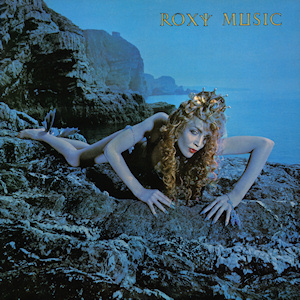
Sound the Siren! Roxy Music’s 1975 classic is 49 years old, so let’s take a look at each track one by one.
Love Is The Drug
I remember hearing this on Mum’s copy of the compilation Street Life: 20 Great Hits. Roxy Music had been living in the record player since I was four years old, thanks to their excellent Manifesto album. The Street Life LP made me even more of a fan, and over the years, I managed to track down their entire back catalogue – some of which were even signed by the great man himself, Bryan Ferry.
As the proud owner of an autographed near-pristine vinyl copy of Siren, it’s my second favourite Roxy album – sorry, Manifesto’s always had a special place in my heart. This is a close contender though, and one of the most fascinating. It’s the crossroads between their earlier art rock leanings and a more danceable solution that they’d take in the future. The result is the best of both worlds, appeasing the fans of Roxy Music’s early days and those who prefer their music to be a bit more accessible.
Love Is The Drug must have been quite the shock to purists, with its roots firmly in the dance halls of 1975. The memorable opening of footsteps trudging along a rain-soaked road and opening a car door gives way to a classic bass riff from John Gustafson. And as the car motors away, Paul Thompson’s tight snare drum kicks in. While it’s not quite at disco level (see Both Ends Burning), Love Is The Drug still pre-empts the heavy funk bass riffs of great bands like Chic.
What’s interesting is that originally saxophonist Andy Mackay wrote a much more old-fashioned version. He explained that its roots began in classical, folk harmony and church music – which is as near to the end product as Britain is to Australia. After a short break, producer Chris Thomas returned to the fold to modernise Love Is The Drug, and make it into a danceable classic that still stands the test of time today. It proved to be the right choice, as it became the band’s biggest hit to date, reaching Number 2 in Autumn 1975.
End Of The Line
“Think I’ll take a walk out in the rain,” muses a wistful Ferry as a mournful harmonica wheezes in the background. This is no Gene Kelly Whirls Around Lamp Posts With A Brolly scenario, though. This is a full-on misery fest as the lyrics turn the weather warnings up to a storm as poor old Bryan declares: “There’s no love to keep me warm inside”.
Siren is a lot more personal than previous albums, and easily relatable to anyone who’s suffered a bad break-up. Many of the nine tracks deal with love and loss with a great big dollop of heartbreak dumped on top. The solemn arrangement of End Of The Line changes direction from the disco club to the prairie, as it sounds a bit country and western. Roxy Music’s previous LP Country Life ended with a track called Prairie Rose, so it’s logical that the theme is carried through on its successor.
Taking the pace down a little after the heady stomp of Love Is The Drug, End Of The Line borders on laconic with its couldn’t-care-less-drowned-rat attitude. But it’s still impeccably arranged, ending on a lone note that segues into…
Sentimental Fool
More of a throwback to earlier days, not just in its more experimental approach (it takes about a minute and a half for the tune to actually kick in, beginning with lots of ambient instrumental noodling), but in a more generous length of six minutes-plus.
I like this a lot, though. Its dreamy atmosphere works a treat, whether it’s through the childlike nursery rhyme tune of the end coda or the effect of each protagonist singing in the left and right speakers. Ferry plays the part of the down-on-his-luck fool and his conscience telling him to wise up (“Oh you silly thing/Can’t you see what’s happening/You’re better without it”). It’s a bit like an art rock version of Jiminy Cricket or Gusteau from Ratatouille.
Plus, it’s one of those tracks where you think that it’s stopped… only to continue!
Whirlwind
If Siren’s lyrics mostly explore failed relationships, at least in 1975, Bryan Ferry was enjoying a high-profile relationship with Jerry Hall. Little did Hall know that at this stage of her life that she would one day trade Ferry in for a Rolling Stone and later still, a shrivelled Davros wannabe.
But in Summer 1975, Hall had been selected as the cover model for her then-beau’s new Roxy album. She was asked to strike a pose while crawling about on rocks close to South Stack, near Anglesey (after Ferry had been inspired by a TV documentary).
Whirlwind itself is a more upbeat rocker, driven by Phil Manzanera’s dervish-like guitar screaming. Mind you, given that Ferry’s and Hall’s romance later ended in tears, perhaps he predicted its outcome by warning “Beware… Whirlwind.”
She Sells
There’s not one clunker to be found on Siren, so choosing a favourite is a hard task. Bit if push came to shove, I’d plump for the unusual She Sells.
I love how this one pans out. A jaunty Eddie Jobson piano opens the track, as the twin powerhouse of Gustafson’s bass and Thompson’s hard-hitting drum progress it into another slab of danceable heavy funk. But just when you think you’ve got a handle on She Sells, the band throw other eccentric ideas into the mix. A sinister violin saws away. The verses slow to a crawl before launching into a disco groove for a nanosecond. Sly puns (“Your lingerie’s a gift wrap/Slip it to me”). At the end, it changes tack, becoming a sinister robotic call and response.
The ending sums up the mechanical reliance on using sex to sell in magazines and papers. Ferry monotonously intones: “Nine till five/The daily grind/Made-up lies/Make up my mind/Same machine/Consuming me, consuming you.” It’s a vicious circle. Fictional titillation is cynically employed to sell in printed adverts, but the protagonist of She Sells falls for the same trick every time.
Could It Happen To Me
Any lovelorn puppy seeking the partner of his or her dreams on First Dates would do well not to quote from Could It Happen To Me.
While the protagonist of the track is clearly smitten with his girlfriend, he’s a neurotic wreck. “Take me as I am,” pleads Ferry. “An average man.” And that’s before he wails about everything that he touches turning to dust and lamenting of the broken heart. This sort of woe would make juicy First Dates fodder, but I can’t see it resulting in a second meet.
Good ditty though. Andy Mackay does a sterling job with the parping oboe/saxophone adding an extra degree of despair to proceedings.
Both Ends Burning
Love Is The Drug may have dipped a dancing shoe into the waters of disco, but the follow-up single Both Ends Burning dives right in with a splash.
Going full hog with a pelting Paul Thompson drum rhythm, accompanying bongos and Jobson pressing down the synthesised ARP strings, Both Ends Burning is a worthy experiment that paves the away for disco-flavoured offerings like Dance Away and the 7” version of Angel Eyes. Lyrically, it bemoans the extra pressure put upon the band – not only in coming up with a new album on time, but also, having to endure the gruelling experience of touring.
Chart-wise, Both Ends Burning didn’t quite have the same spark, only managing a decidedly tepid Number 25 in the charts. It was the last chart hit the band would have for over three years – apart from a re-released Virginia Plain in 1977. Ferry would plough on with his solo career, but it wouldn’t be until early Spring 1979 that Roxy Music returned to the charts.
Nightingale
A gentle palate cleanser after the frantic rush of Both Ends Burning. Nightingale may not be the most dynamic cut on the LP, but it’s still head and shoulders above anything churned out today.
A nice acoustic guitar solo in the middle from Manzanera and Mackay’s downbeat oboe conjure up a peaceful walk in the country on a cloudy Autumn day. A good one for the iPod if you’re taking a leisurely stroll in the woods.
Just Another High
Most of Siren’s lyrics aren’t exactly celebrating the joys of love. But at least Just Another High does its best to reflect on a doomed affair with a philosophical shrug and a wry grin. “Maybe I should start anew,” sings Ferry before realising that “Maybe I’m too stuck on you.” The poor chap can’t catch a break.
A fine sign-off to the album, strutting away in slow-burning rock style. Overall, Siren is one of the must-buys for any new Roxy Music fan. Despite the many paeans to lamented love, it never gets too maudlin, trying out a range of musical genres to keep things fresh and interesting. The crisp musicianship tops off an album that successfully combines the past and future. The first chapter of Roxy Music may have ended with Siren, but a new one was about to begin later in the ’70s.
(Cover art credited to Graham Hughes, based on an idea by Bryan Ferry and sketches by Antony Price)
If you liked this article, you might like some of my other books which are available to download at Amazon:
https://www.amazon.co.uk/s?i=digital-text&rh=p_27%3AJOHN+BENSALHIA&s=relevancerank&text=JOHN+BENSALHIA&ref=dp_byline_sr_ebooks_1
