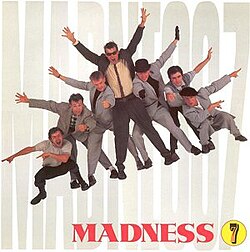
Revisiting the pinnacle of Madness’ music, here’s a track-by-track discussion of the magnificent Seven…
Cardiac Arrest
The Summer of 1986 was the point when I became a mad record collector. After buying my first album in Autumn 1982, there was a near four-year gap – mainly because my folks’ old record player didn’t work too well, jumping and sticking like a malfunctioning popcorn-making machine.
When Mum and Dad bought a new stack hi-fi system in ’86, I became obsessed with records again. The day after I left primary school, I decided to treat myself to a new album with the pennies I’d saved from pocket money. Because my first album was the Madness compilation, Complete Madness, I wanted some of their previous LPs pictured on the back. The one that caught my eye the most was their third LP, Seven. And so it came to pass that Seven became my second.
While nostalgia plays its part in my fondness for Seven, I still say it’s Madness’ finest moment. It’s the perfect mix of topical commentary and Nutty Sounds which were branching out into more experimental waters. A common trick that Madness play is to mesh upbeat, jolly ska pop with downbeat subject matter. No sooner has the needle landed in the groove at Track One, I’m presented with one of the very best examples.
Cardiac Arrest tells the tale of an uptight businessman who’s so obsessed with his workaholic regime that he keels over from a stress-related heart attack. According to the sleeve notes on the back of Complete Madness, Chas Smash explained that he based the lyrics on an actual first-hand experience of seeing someone have a heart attack on his way to work. He turned the experience into a cautionary ditty of putting life before stress. “It’s a lovely day, could all be going your way,” shrugs Suggs in the first chorus. “Take the doc’s advice, let up, enjoy your life.”
The heartbeat-like thud in the intro is a perfect curtain-raiser to this great bit of Madness. It’s one of my favourites by the seven, mixing the macabre with the jolly. I love the glockenspiel solo in the middle, although if I had one complaint, the album version’s break is shorter (it also comes to a more abrupt end with a return to the heartbeat pounding that gradually slows down to the point of expiry – the single version merely fades out on the repeated chorus).
Although it’s in my Top 3 of Madness tracks, Cardiac Arrest didn’t quite have the same popularity with the record buyers. The most likely reason is that its dark subject matter didn’t guarantee as much airplay, so it stalled at Number 14 in early 1982. For me though, this is peak Madness.
Shut Up
As Chris Foreman rhetorically asks in the Complete Madness sleeve notes, why call a song Shut Up when there isn’t any mention of Shut Up in the lyrics?
The story goes that the original version did mention Shut Up, but the lyrics were subsequently reworked to remove the phrase, but it was retained as the title for sentimental reasons. Supposedly.
The second single from Seven, Shut Up gained an appropriate lucky number position in the charts a couple of weeks before the parent album hit the shops. A witty tale of a convicted petty criminal passing the blame on to anyone but himself, this rollicks along at a cracking pace, and apparently features a Foreman solo on Dave Hill from Slade’s old guitar.
Like Cardiac Arrest, the album version of Shut Up differs a little. Whereas the opener was shorter than the single, the album version of Shut Up is longer, extending the ending to give you a bonus Barson piano solo that slowly fades out.
Sign Of The Times
Even in the days before cynical clickbait-y headlines, tabloid trash was still deemed as only useful for tomorrow’s fish and chip wrappers.
Madness perfectly capture that sneering disdain of newspaper reporting in Sign Of The Times, a breezy ditty which – like its 12 bedfellows – could have been plucked as a single to storm the charts. Instantly catchy on first listen, the lyrics take no prisoners in this trashing of the trash. “This is your Englishman, this is his lawn,” quips Suggs. “This is your female, undone and torn”, summing up tabloid content in just a couple of sentences.
The appeal of early Madness albums is the dark humour. I wouldn’t have been surprised if one of the rags had attempted to use the chorus in a TV advert, most likely not getting the irony of “We are the people and we really care, we don’t really look, we just like to stare.” Funny and danceable at the same time, Sign Of The Times makes it three for three on Seven.
Missing You
While much of Seven dabbles with social commentary and topical subject matter (but without the joyless finger-wagging of today’s empty pop fodder), the album does occasionally venture into more personal territory.
Missing You does what it says on the tin, lamenting the separation from a loved one. It’s a great mood-builder, with particular emphasis on Barson’s recurring piano signature, heavy drum thumping from Woody Woodgate and an interesting echo-y treatment of Suggs’ vocals. Even extra flourishes such as bongo percussion in the last verse and the mad maelstrom of saxophone from Lee Thompson in the instrumental break add up to that ambience of claustrophobic separation anxiety.
Mrs Hutchinson
If Cardiac Arrest had got close to the bone with its fusion of chirpy ska pop and dark subject matter, then Mrs Hutchinson takes it to the max.
The story of a dying woman who literally only has days to live is incongruously set to a jolly party conga. It shouldn’t work, but it does. In fact, the happy carnival sounds only make the lyrics more haunting. Mike Barson cleverly tells the tale from a doctor, dishing out superficially mundane advice to his patient (“Come on, eat your breakfast”, “Stick to your diet, let’s hope that you’re insured”, etc) one minute and then saving the sobering truth for her son the next (“Are you thirsty son, I think you’ll need a drink, there’s been some complications, she’s very near the brink…”).
In fact, Mrs Hutchinson was apparently written from Barson’s own personal experience, after his mum had been misdiagnosed with cancer. But for the many who have been in this nightmarish position, the bitingly accurate lyrics still ring true.
Tomorrow’s Dream
It would be easy to write Madness off as lightweight pop skasters, but that would be criminally ignoring their immense talent, both musically and lyrically. Seven showcases both gifts, with a prime example being the anti-vivisection Side One closer, Tomorrow’s Dream.
The trick with many a Madness track is to pen it through an individual’s eyes. Tomorrow’s Dream puts you in the mindset of a trapped, terrified animal (“A cage of my own, this cage is my home, and oh so alone am I”), and its clever wordplay (“You can’t burn me with your laser beam, it’s pointed at you and Tomorrow’s Dream”) is well matched by the musical quirks. When Suggs sings of his “brother’s cry”, Thompson uses the saxophone to create terrified, frantic squeaks. Like its predecessor, Tomorrow’s Dream simultaneously gives you a tune that you can dance along to while chewing over the more serious matter of the lyrics.
Those who bought the Driving In My Car single in Summer ’82 could sample a specially remixed version of Tomorrow’s Dream. Largely instrumental, it was reworked under the new name of Animal Farm.
Grey Day
The first fruits of Seven’s labours, Grey Day was the teaser for the album way back in the Spring of 1981. Its genesis apparently goes as far back as 1978 in the days before the band became famous. The Complete Madness sleeve notes from Barson explain that the original version of Grey Day was a more radical take that apparently based its pattern on Roxy Music’s moody 1973 workout, The Bogus Man.
Mind you, Madness fans would still have detected a shift in the dynamics when the single was released to great fanfare (and achieving a Number Four spot in the charts). The band had been moving to murkier subject areas on Absolutely, but Grey Day saw a tonal shift on two counts – one, more sophisticated but still accessible arrangements and two, even darker lyrics.
Grey Day’s reggae-tinged, fairgroundy climate is at odds with its bleak words. Maybe Barson had only meant to convey a generic apocalyptic nightmare scenario, but it’s still a strikingly on-the-nose depiction of everyday depression. That empty pointlessness is captured to a tee in but four chorus lines: “In the morning I awake, my arms, my legs, my body ache, the sky outside is wet and grey, so begins another weary day.” Shockingly good.
Pac-A-Mac
Pac-A-Mac turns that frown upside down with a bit of Carry On-style innuendo. In 1986, 11-year-old me took the lyrics at face value as a bloke putting on a mac to protect himself from the rain. Dear, sweet, innocent John Bensalhia… you fool.
With lines like “Inside a rubber wall yelling, screams echo off the ceiling”, you’d have to be clueless to not get the single-entendre meaning of Pac-A-Mac. Between the darker subject discussions of Seven, it’s nice to get a disposable bit of nonsense – although having said that, the music played is still first rate.
Promises Promises
If I had to pick a weak link on Seven, it would be Promises, Promises. While it’s by no means a complete disaster, it’s not as strong as some of the others – either musically or lyrically, with its literal promises of grandeur far beyond anyone’s reach.
I think this is where the band start to go wrong after Seven. The Mads’ next album, Rise And Fall, will suffer from this problem a lot more, with too many forgettable tracks on Side Two, and from then on, much of Keep Moving and virtually all of Mad Not Mad lose the momentum that was built up in those first three years.
While it deserved to go all the way to Number One on the album charts, Seven still did well, reaching Number Five in the UK in a run that exceeded over six months. It also matched that position in Holland, but in a run that lasted 17 weeks.
Benny Bullfrog
Contradictory as ever, I actually quite like the silliness of Benny Bullfrog whereas with something like Yellow Submarine on The Beatles’ Revolver, I’d scornfully dismiss it as kids’ filler.
Maybe it’s because Seven frequently delves into darker subject matters, so tracks like Benny Bullfrog come as a refreshing palate cleanser. It is mind-numbingly daft, but 11-year-old me liked it a lot, and since those days are getting mistier by the second, I’ll cling on to those memories as much as I can.
From what I remember though, I seem to recall reading an interview in which one of Madness – I forget which one – sniffily criticised the track. I think he said something like “We don’t want to put out another album of Benny Bullfrogs”, and while there’s nowt wrong with maturing and broadening your musical horizons, for me personally, Madness lost that appealing joie-de-vivre after Complete Madness. But for those first few years, they provided the best nutty sounds in town.
When Dawn Arrives
Back to the grittier subject matter and this sordid tale of a rent boy tries a different musical tack. Whereas stuff like Cardiac Arrest and Mrs Hutchinson were lighter and more poppy in tone, When Dawn Arrives is wilfully melancholic by contrast.
The main motif of the track is that downbeat harmonica, guiding you through the murky streets of London as Suggs’ part-sings, part-narrates this story of a lad paying his rent by whatever means necessary. An effective yin to the majority of the album’s yang.
The Opium Eaters
The instrumental interlude had become a staple part of Madness albums. One Step Beyond brought you Swan Lake, while Absolutely signed off with the hit single The Return Of The Los Palmas Seven.
If you’re going to be super-picky, Swan Lake ends with a barely audible scream of “YES!” while Los Palmas has a request of “Waiter” (plus a morose “Goodnight” on the album version), but The Opium Eaters is totally word-free. No lyrics, but what atmosphere. Mike Barson’s superlative piano work fills in the gaps to perfection, and there’s also some great guitar work from Chris Foreman. I love that wistful fade-out of Barson’s stark piano notes and gloomy glockenspiel into the night.
Day On The Town
Madness’ dichotomy between the chirpy and chilling is at its best on Seven and it gets one more shot on the closing Day On The Town, which on the one hand takes you on an open-topped double decker bus ride around London and then on the other, reminds you of urban unrest and riots taking place in the city underneath your nose.
While sadly my original vinyl copy of Seven got washed away with all my other records in a flood, I did get the spruced up CD copy (right down to the quirky vinyl labels with the Side One back view of the band in the cover pose on one disc and then Side Two Woody on his lonesome on the other). One thing I did notice was that the CD version of Day On The Town is different to the vinyl one, notably at the end, which extends the instrumental madness for a lot longer – complete with disorientating sound effects, screams and noises.
Easily the best Madness album by a long chalk, Seven also ranks as one of the essential album buys of the ’80s. A true classic.
(Cover art credited to Stella Artwork, C-More and Mike Putland)
If you liked this article, you might like some of my other books which are available to buy at Amazon:
Amazon.co.uk: JOHN BENSALHIA: books, biography, latest update
