Some say that knowledge is something that I never have, but that’s not going to stop me from blogging about Kate Bush’s eccentric 1982 classic…
Sat In Your Lap
With three hit albums under her belt (and if you’ve got extra time to kill or more likely suffering from insomnia, you can read my review of Never For Ever elsewhere at my blog), Kate Bush chose to self-produce her fourth, The Dreaming.
Recorded over a two-year period, The Dreaming wasn’t as big a seller as Kate’s previous efforts. Its quirky eccentricities didn’t click with a chart-buying public who were too busy with stuff like The Kids From Fame, Nicole and The Goombay Dance Band.
Critically, The Dreaming has been reappraised over the years for its wildly experimental approach. The first fruits of the album were heard a year in advance with the brilliantly nutty Sat In Your Lap, when it was released as a single in the Summer of 1981. Kate’s previous singles were by no means conventional, taking in the whole subject spectrum of an unborn foetus contemplating nuclear war to an Emily Bronte classic novel, but Sat In Your Lap pushed the oddball envelope even further.
By The Dreaming’s standards, Sat In Your Lap is decidedly commercial, even if it would be considered wilfully avant-garde by most casual listeners. The thudding Preston Hayman drum rhythm is the core of this manic three and a half minutes, over which Kate alternately sings, screams and shouts about the ongoing quest for knowledge and wisdom. Some crave it, some have it, some misuse it, some lack it.
On top of this, Sat In Your Lap’s tribal soundscape is boosted by both Hayman and Bush’s brother Paddy on bamboo sticks. Also thrown in to the mix is Kate’s own sterling piano work and one-time Buggles/Asia/Yes man Geoff Downes on CMI trumpets. The whole shebang just missed the Top 10, but it remains one of the most fascinating tracks in the Kate Bush pantheon – and the equally loopy video in which Kate roller skates around with sinister dunce hatted oddballs and creepy jesters is just as striking.
It turned out that this was my most played Kate Bush track on my iPod, which is no great surprise. It’s one of those all-time winners for me. Knowledge really is ho-ho-ho.
There Goes A Tenner
Cockney accents in rock and pop. Where do we stand with this, then?
Some can do it. Others sound like Dick Van Dyke in Mary Poppins or David Tennant in Doctor Who, a consequence of ordering a Time Lord from Wish. It’s not for want of trying. The likes of Steve Marriott, Phil Collins, Kate Nash and that man from The Feeling have all gone Gorbloymey, Apples ‘n’ Pears with varying degrees of success. In the cases of Nash and The Feeling bloke, less rather than more.
Even Kate Bush wasn’t immune from this Cockney Craziness, and maybe that’s why There Goes A Tenner didn’t see the notes in the tills when it was released as a single. Commercially, a problem with The Dreaming is that it doesn’t offer a wide pool of guaranteed successes. Personally, I love There Goes A Tenner, its paranoid beat, piquant chords, and those dreamscape pauses for breath in between verses. It can do no wrong in my eyes, but for those seeking out a catchy singalong, this tale of a blundered bank robbery isn’t as accessible.
There are some great promo videos to go with There Goes A Tenner though. There’s the official one in which Kate and her motley crew cavort around a bank vault in what seems to be the depths of the earth. The far more entertaining one is Kate’s appearance on kids’ pop magazine show, Razzmatazz, in which she and two dancing robber goons strut their stuff in anarchic fashion. Whether Kate’s mugging wide-eyed faces for the camera or dodging obvious flying CSO pound notes, the kids in the audience are either lapping it up or are just plain baffled. Priceless.
Pull Out The Pin
Having seen a documentary about the Vietnam War, Kate was inspired to put pen to paper and write about what she had just witnessed. In 1982 interviews with Robin Smith and Kris Needs, she explained that she wanted to depict both sides of the fight. On the one side, the documentary portrayed the Americans as a Coke guzzling, ice cream spooning and hash smoking race, to the point where you could smell them coming from a mile off. On the other, Bush was fascinated by the Vietnamese customs such as wearing a Buddha on a chain, which the soldiers would then pop in their mouths prior to attack. In the case of death, they would then exit this mortal coil with Buddha on their lips.
The claustrophobia of the war is conveyed well in the music – a grungy, moody soundscape that features her old chum Dave Gilmour on backing vocals. Ambitiously throwing in various musical tricks such as strange Eastern sound effects, tribal percussion and heavy piano, Pull Out The Pin’s exploration of the horrors of combat is boiled down to its base, primal instincts with Kate’s repeated hollers of “AND I LOVE LIFE! I LOVE LIFE! I LOVE LIFE!” Almost like a mantra chanted by the soldiers as a means of clinging on to a hope of a life.
Suspended In Gaffa
Released as a single, but it failed to chart in the UK. It was a middling hit in France, Spain and the Netherlands, but the Baroque Waltz style of Suspended In Gaffa wasn’t what the record buying public wanted on Kate’s home soil. She’d gone to the trouble of making a video and all – a more back to basics promo in which she dances around what seems to be a disused chicken shack.
The Dreaming deals in big concepts and ideas, and Suspended In Gaffa is no exception. A bit like Sat In Your Lap, it’s about attainment – but whereas Sat In Your Lap mused upon how different people treat attainment of knowledge, Suspended In Gaffa looks at how attainment is out of reach unless you genuinely work hard towards achieving it.
Another way to read it – and how Kate approached it (as she explained in a 1985 MTV interview) was that her Roman Catholic upbringing would offer a tantalising glimpse of God in purgatory, whom you wouldn’t see again until you went to heaven.
Leave It Open
The phased guitar from Alan Murphy closes out Side One in which Kate Bush compares us human folk to cups.
That’s not me being an arty farty critic, that’s again what Kate said, when she spoke to NME’s Richard Cook in 1982. The problem is that humans never quite get the balance right: too open or too closed – either gabbling away ten to the dozen – or being too close-minded to take other people’s opinions on board.
The point of which still stands today, 44 years later. And probably will another 44 years after that, repeating the pattern into infinity.
The Dreaming
Commercially, the warning signs must have been flashing when the title track was released as a single a couple of months ahead of the album. Whereas Kate’s 45rpm releases tended to sell well – not always Number One material by any means, but a consistent chart presence – The Dreaming was the first to miss the Top 40 since Hammer Horror nearly four years previous.
The most likely cause is that it was throwing too much at the listener. A high-concept tale of greedy destruction of traditional Aboriginal territory, The Dreaming chucks in everything but the kitchen sink – Kate adopting a cod Australian accent, traditional Australian musical instruments, extra chanting voices, and even animal impersonator Percy Edwards doing sheep noises. It was probably too much for casual record buyers, and even a visually arresting promo video couldn’t nudge the single beyond Number 48 in the charts.
Likewise, The Dreaming album – while achieving a decent Number Three in the charts – only stuck around for 10 weeks. A further two week visit was booked in early Autumn 2014, but this was still Kate’s least successful album at the time. It’s a shame, since a lot of the music contained inside is some of the most richly compelling that Bush ever produced, but perhaps stuff like the title track was just a bit too much to take for some.
Night Of The Swallow
This is more like it – although when released as a single, like Suspended In Gaffa, it was swallowed up whole by the charts. There’s the sense that Kate had lost faith in the charts at this time, since no promo video was ever made.
The star of Night Of The Swallow is Del Palmer’s fretless bass, which was a key ingredient on Never For Ever. That’s not to do the Irish musicianship a disservice, as the pipes, penny whistle, bouzouki and fiddle all combine to create a unique Celtic ambience on this unusual tale of a smuggler’s lover begging him not to undertake another journey into the unknown.
One of the earliest tracks to be laid down for the album, Night Of The Swallow is abundant in atmosphere and I really like the way in which it alternates between slow contemplation and frantic energy. Bush was delighted to be working with Planxty members Bill Whelan, Liam O’Flynn and Donal Lunny, and their contributions are worth their weight in smuggler’s gold.
All The Love
Another favourite of mine on the album, this delicate piano ballad is like a fine wine, getting better with age. All The Love isn’t a love song that promises a romantic candlelit meal for two and Valentines Day card swooning, but instead looks at the fragility of loneliness and how actually, so many forget to say those three important words.
Unusual chord choices always appeal, and All The Love is no exception with its strange, free-falling piano keys. The eerie verse-break soprano voice is another strange but effective addition, and contributes much to the ethereal atmosphere.
Another notable surprise is the ending in which various answerphone messages overlap. In a Kate Bush newsletter from 1982, she explained that she had several cassettes’ worth of answerphone calls, which she then spliced together to create that oddball coda. Apparently, there were various friends of Kate’s who wondered why they’d received an album credit on The Dreaming when they hadn’t even set foot in a recording studio.
Houdini
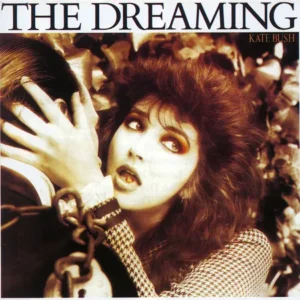
When Kate Bush went on the first edition of Saturday Superstore as part of The Dreaming’s promotional roadshow, she explained how the distinctive cover photo related to one of the tracks.
The track in question comes near the end of The Dreaming. Houdini is told from the point of view of Harry Houdini’s wife (whom Kate is dressed up as on the cover – complete with gold key in mouth), and how she is trying to make contact with him after the escapologist and illusionist had passed away.
Bush explained in an interview with Poppix that Houdini had been highly sceptical of most spiritualists, but he’d made a pact with his wife that if ever he passed away and she wanted to try and contact him from the other side, the couple would work out a special code to make sure that the link was genuine. Sure enough, on one occasion, Harry did make contact with Bess, the story of which moved Kate to immortalise this in song.
Which she did with great flair.
Get Out Of My House
HEE HAAAAAWWWWW!!!
“It’s meant to be a bit scary,” explained Kate to Kris Needs when chewing the fat about the discombobulating mania of Get Out Of My House. Concluding The Dreaming in typically high concept fashion, Kate moved away from comparing the human body with a cup to comparing it with a house. That sense that people become more protective over time, metaphorically putting up shutters and locking doors – only allowing certain individuals in to wipe their feet on the doormat.
The other common link with much of Kate’s work is using source material as its springboard. In this case, Kate cites Stephen King’s The Shining as inspiration, with the human body shut up and bolted to prevent any unwanted visitors from getting in. Plus, like The Shining, the musical tone of Get Out Of My House is wonderfully unsettling. The furiously relentless drum pattern echoes the defiance in the lyrics, with Kate flitting between lower register menace and repeated banshee-like screams of “GET OUT OF MY HOUSE!” By the time the track’s Eeyore-d itself out of existence, you might need a quiet lie down in a locked room.
Magnificently barking – much like the rest of The Dreaming. If you’re seeking a quick-fix good time album, this won’t be the one for you. But if you’re after something that’s a bit more of a challenge – both musically and conceptually – and you like a bit of quirky on your iPod (like me), The Dreaming could well be your dream album.
(Cover design credited to John Carder Bush, Nick Price, Bill Clark, Kindlight)
If you liked this article, you might like some of my other books which are available to buy at Amazon:
Amazon.co.uk: JOHN BENSALHIA: books, biography, latest update
